B. Majusi / Zoroaster
Merupakan ajaran Zarathustra yang lahir 258 tahun sebelum Iskandar Agung atau sekitar abad ke-6 SM. Pokok ajarannya terkandung dalam kitab suci Zean Avesta (zean = penjelasan, avesta = hukum). Zarathustra mengajarkan adanya dewa-dewa yang terbagi dua bagian, yang tertinggi Ahura Mazda (Ormudz) adalah Tuhan Terang (Lord of Light) memancarkan Vaho Manah (pikiran baik), Asha Vahista (keadilan tertinggi), Khashathra Vairya (kerajaan Tuhan), Spenta Aramaiti (kebaktian saleh), Haurvatat (keselamatan) dan Ahriman (Agramanyu) adalah tuhan gelap (spirit of evil) memancarkan berbagai sifat kejahatan dan keburukan. Peperangan antara kedua golongan dewa tersebut menimbulkan konsepsi tentang kejadian alam (kosmogini) dan eschatologi.
Salah satu aliran yang besar pengaruhanya adalah aliran Manes (Manichanism school) yang dikalangan theologi Islam dikenal dengan sebutan kaum zindik. Manes hidup sekitar pertengahan abad ke-3 SM. yang kemudian mengaku dirinya sebagai Nabi pembaharu agama Zoroaster. Didalam ajaran-ajarannya tampak pengaruh Budhisme dan Gnoticisme dengan bertitik tolak dari dualisme zoroaster. Yang terpenting dari ajarannya adalah pemberian arti kerohanian dari pergulatan antara terang dan gelap dalam ajaran zoroaster tersebut.
Dalam rangka pengertian kerohanian itulah pengikutnya diwajibkan untuk bertapa dan berlaku zuhud, tidak boleh kawin, berpuasa terus-menerus paling tidak 7 hari dalam sebulan, bersembahyang terus menerus dan sekurangnya 12 kali sujud kepada matahari terbit sebagai lambang dari dewa Ahura Mazda, tidak menyembelih binatang dan meninggalkan dunia ramai. Pertarungan antara yang baik (terang) dengan yang buruk (gelap) dalam diri seseorang mengharuskan semua ketentuan ini dilaksanakan dan akhirnya jiwa harus dapat mengalahkan keburukan (kegelapan).
C. Filsafat India
Anak benua India ditaklukkan oleh Jendral Muhammad Al-Qasim atas perintah Hajjaj bin Yusuf, panglima Khalifah Abdul Malik bin Marwan dari Bani Umayyah. Penduduk India sudah menganut agama Hindu dan Budha. Bangsa India juga sudah terpengaruh budaya Hellanisme ketika seelumnya pernah ditaklukkan oleh Alexander Agung.
Hinduisme
Menurut ajaran Hindu, konsepsi tentang diri (self) merupaka sesuatu yang menarik. Diri itu adalah sesuatu yang abadi, tidak dilahirkan dan tidak pernah mati, merupakan konsepsi yang jelas tampak dalam Weda dan Bhagawat Gita. Setiap diri (self) selalu identik dan bersifat tetap. Disamping diri, dimiliki macam ragam hal dan keadaan yang tidak tetap dan selalu berubah, dan ini bersumber dari pengalaman. Dalam hubungannya dengan jagad raya, ia bersumber dari yang tidak berubah, mutlak dan universal dalam bentuk kenyataan yang dijumpai dalam kekhususan yang mempunyai banyak ragam bentuk dan sifatnya yang selalu berbah dan saling bertentangan. Diantara diri dan dan pengalaman alamiah itu manusia meski mendirikan kehidupan. Dalam hal ini, masih banyak yang belum diketahuinya dan filsafat India mengangkat masalah ini dalam filsafat maya. Filsafat India menyatakan bahwa dalam memecahkan masalah maya, hendaknya jangan melalui kemampuan rasio, tapi menggunakan batin. Sebagaimana Plato dan Kant di dunia Barat, maka Nagarjuna dan Samsara dari India menyatakan bahwa pikiran (rasio) kita hanya bersangkut paut dengaan hal-hal yang relatif dan tidak berkaitan dengan hal yang mutlak.
Meskipun ada wujud yang mutlak itu tidak diketahui melalui ratio namun masih bias dirasakan dan kemudian dipecahkan melalui perasaan. Ada (wujud) dan diri (self) adalah kesatuan kenyataan dari yang paling rahasia dan paling mendalam dan tidak ada yang mengetahuinya kecuali diri itu sendiri.
Inilah pokok-pokok pikiran wihdatul wujud dalam alam pikiran Advaita yang dianut oleh Gaudapada dan Samkara. Dari pokok pikiran itu berkembang lebih lanjut bahwa dunia adalah kesamaan yang telah menjadi perbedaan. Yang satu tidak terasing dari yang lainnya, sedang Tuhan adalah tempat yang paling dalam, pangkal kebersamaan semesta. Dunia adalah bentuk lahir daripadanya.
Kitab-kitab Upanisad, Veda, Baghawat Gita penuh dengan pikiran-pikiran Wahdatul Wujud, Inkarnasi dan Reinkarnasi roh dan sebagainya. Dari pikiran-pikiran itu menunjukkan bahwa alam semesta itu bukan dijadikan dari tidak ada menjadi ada (creatio ex nihilo) tetapi ia berasal dari sesuatu yang sudah ada hanya mengalami perubahan bentuk. Ia menggambarkan bahwa alam semesta ini tidak ubahnya seperti sebuah besi yang amat pijar membara dalam api yang begejolak mengeluarkan cahaya dan lentingan-lentingan bara. Dunia ini adalah sebiji lentingan bara dari besi pijar tersebut, maka alam semesta ini bukanlah dijadikan dari tidak ada menjadi ada tetapi merupakan limpahan daripadaNya. Pemikiran itu diungkapkan oleh filsuf Muslim yaitu Al-Biruni (440 H/1048 M) dalam alam pikiran Islam dalam bukunya Tahqiq ma lil hindi min Maqulah dan Al-Itsarul Baqiyah.
Disamping itu diterjemahkan juga Siddarta dari Brahmagupta, suatu risalah tentang Astronomi yang dilakukan oleh Fazari yang kemudian memainkan peranan penting dalam perkembangan Astronomi dalam Islam. Sejak Abu Ja’far Al-Mansyur berkuasa, telah dilakukan penerjemahan berbagai buku tentang medis India dan lain-lain bidang ilmu, terutama pada masa menteri Yahya Al-Barmaki.
Buddhisme
Filsafat Budhisme menitik beratkan ajarannya untuk selalu berperilaku baik, berpikiran dan berniat baik, melakukan meditasi, mengekang keinginan hawa nafsu agar jiwa manusia lepas dari samsara (keinginan-keinginan rendah) untuk mencapai nirwana yaitu suasana batin yang damai, lepas dari pengaruh semua keinginan-keinginan, yang disebut Moksha.
Sumber: Filsafat India – Heinrich Zimmer, http://ahmadfaruq.blogdetik.com, http://dalamdakwah.wordpress.com
Thursday, November 10, 2011


Ilmu Kalam (Ushuluddin III)
B. Majusi / Zoroaster
Merupakan ajaran Zarathustra yang lahir 258 tahun sebelum Iskandar Agung atau sekitar abad ke-6 SM. Pokok ajarannya terkandung dalam kitab suci Zean Avesta (zean = penjelasan, avesta = hukum). Zarathustra mengajarkan adanya dewa-dewa yang terbagi dua bagian, yang tertinggi Ahura Mazda (Ormudz) adalah Tuhan Terang (Lord of Light) memancarkan Vaho Manah (pikiran baik), Asha Vahista (keadilan tertinggi), Khashathra Vairya (kerajaan Tuhan), Spenta Aramaiti (kebaktian saleh), Haurvatat (keselamatan) dan Ahriman (Agramanyu) adalah tuhan gelap (spirit of evil) memancarkan berbagai sifat kejahatan dan keburukan. Peperangan antara kedua golongan dewa tersebut menimbulkan konsepsi tentang kejadian alam (kosmogini) dan eschatologi.
Salah satu aliran yang besar pengaruhanya adalah aliran Manes (Manichanism school) yang dikalangan theologi Islam dikenal dengan sebutan kaum zindik. Manes hidup sekitar pertengahan abad ke-3 SM. yang kemudian mengaku dirinya sebagai Nabi pembaharu agama Zoroaster. Didalam ajaran-ajarannya tampak pengaruh Budhisme dan Gnoticisme dengan bertitik tolak dari dualisme zoroaster. Yang terpenting dari ajarannya adalah pemberian arti kerohanian dari pergulatan antara terang dan gelap dalam ajaran zoroaster tersebut.
Dalam rangka pengertian kerohanian itulah pengikutnya diwajibkan untuk bertapa dan berlaku zuhud, tidak boleh kawin, berpuasa terus-menerus paling tidak 7 hari dalam sebulan, bersembahyang terus menerus dan sekurangnya 12 kali sujud kepada matahari terbit sebagai lambang dari dewa Ahura Mazda, tidak menyembelih binatang dan meninggalkan dunia ramai. Pertarungan antara yang baik (terang) dengan yang buruk (gelap) dalam diri seseorang mengharuskan semua ketentuan ini dilaksanakan dan akhirnya jiwa harus dapat mengalahkan keburukan (kegelapan).
C. Filsafat India
Anak benua India ditaklukkan oleh Jendral Muhammad Al-Qasim atas perintah Hajjaj bin Yusuf, panglima Khalifah Abdul Malik bin Marwan dari Bani Umayyah. Penduduk India sudah menganut agama Hindu dan Budha. Bangsa India juga sudah terpengaruh budaya Hellanisme ketika seelumnya pernah ditaklukkan oleh Alexander Agung.
Hinduisme
Menurut ajaran Hindu, konsepsi tentang diri (self) merupaka sesuatu yang menarik. Diri itu adalah sesuatu yang abadi, tidak dilahirkan dan tidak pernah mati, merupakan konsepsi yang jelas tampak dalam Weda dan Bhagawat Gita. Setiap diri (self) selalu identik dan bersifat tetap. Disamping diri, dimiliki macam ragam hal dan keadaan yang tidak tetap dan selalu berubah, dan ini bersumber dari pengalaman. Dalam hubungannya dengan jagad raya, ia bersumber dari yang tidak berubah, mutlak dan universal dalam bentuk kenyataan yang dijumpai dalam kekhususan yang mempunyai banyak ragam bentuk dan sifatnya yang selalu berbah dan saling bertentangan. Diantara diri dan dan pengalaman alamiah itu manusia meski mendirikan kehidupan. Dalam hal ini, masih banyak yang belum diketahuinya dan filsafat India mengangkat masalah ini dalam filsafat maya. Filsafat India menyatakan bahwa dalam memecahkan masalah maya, hendaknya jangan melalui kemampuan rasio, tapi menggunakan batin. Sebagaimana Plato dan Kant di dunia Barat, maka Nagarjuna dan Samsara dari India menyatakan bahwa pikiran (rasio) kita hanya bersangkut paut dengaan hal-hal yang relatif dan tidak berkaitan dengan hal yang mutlak.
Meskipun ada wujud yang mutlak itu tidak diketahui melalui ratio namun masih bias dirasakan dan kemudian dipecahkan melalui perasaan. Ada (wujud) dan diri (self) adalah kesatuan kenyataan dari yang paling rahasia dan paling mendalam dan tidak ada yang mengetahuinya kecuali diri itu sendiri.
Inilah pokok-pokok pikiran wihdatul wujud dalam alam pikiran Advaita yang dianut oleh Gaudapada dan Samkara. Dari pokok pikiran itu berkembang lebih lanjut bahwa dunia adalah kesamaan yang telah menjadi perbedaan. Yang satu tidak terasing dari yang lainnya, sedang Tuhan adalah tempat yang paling dalam, pangkal kebersamaan semesta. Dunia adalah bentuk lahir daripadanya.
Kitab-kitab Upanisad, Veda, Baghawat Gita penuh dengan pikiran-pikiran Wahdatul Wujud, Inkarnasi dan Reinkarnasi roh dan sebagainya. Dari pikiran-pikiran itu menunjukkan bahwa alam semesta itu bukan dijadikan dari tidak ada menjadi ada (creatio ex nihilo) tetapi ia berasal dari sesuatu yang sudah ada hanya mengalami perubahan bentuk. Ia menggambarkan bahwa alam semesta ini tidak ubahnya seperti sebuah besi yang amat pijar membara dalam api yang begejolak mengeluarkan cahaya dan lentingan-lentingan bara. Dunia ini adalah sebiji lentingan bara dari besi pijar tersebut, maka alam semesta ini bukanlah dijadikan dari tidak ada menjadi ada tetapi merupakan limpahan daripadaNya. Pemikiran itu diungkapkan oleh filsuf Muslim yaitu Al-Biruni (440 H/1048 M) dalam alam pikiran Islam dalam bukunya Tahqiq ma lil hindi min Maqulah dan Al-Itsarul Baqiyah.
Disamping itu diterjemahkan juga Siddarta dari Brahmagupta, suatu risalah tentang Astronomi yang dilakukan oleh Fazari yang kemudian memainkan peranan penting dalam perkembangan Astronomi dalam Islam. Sejak Abu Ja’far Al-Mansyur berkuasa, telah dilakukan penerjemahan berbagai buku tentang medis India dan lain-lain bidang ilmu, terutama pada masa menteri Yahya Al-Barmaki.
Buddhisme
Filsafat Budhisme menitik beratkan ajarannya untuk selalu berperilaku baik, berpikiran dan berniat baik, melakukan meditasi, mengekang keinginan hawa nafsu agar jiwa manusia lepas dari samsara (keinginan-keinginan rendah) untuk mencapai nirwana yaitu suasana batin yang damai, lepas dari pengaruh semua keinginan-keinginan, yang disebut Moksha.
Sumber: Filsafat India – Heinrich Zimmer, http://ahmadfaruq.blogdetik.com, http://dalamdakwah.wordpress.com
Wednesday, November 9, 2011
Ilmu Kalam (Ushuluddin II)
A. Filsafat Yunani
Ciri khas filsafat Yunani adalah pemikiran bebas yang tidak terikat oleh agama. Jiwa filsafat Yunani adalah mengamati, memikirkan dan merenungkan segala sesuatu berdasarkan rasio (akal).
Neo Platonisme
Plato adalah seorang filsuf Yunani Kuno yang utama, guru dari Aristoteles. Ajaran Plato banyak terpengaruh Sokrates yang berusaha menentukan hakikat keadilan-keadilan dan keutamaan-keutamaan lain. Menurut Plato hakikat itu memiliki realitas, terlepas dari segala perbuatan kongkrit. Idea keadilan, idea keberanian dan idea lain memang ada dan idea-idea itu tidak diciptakan oleh pikiran manusia. Idea itu sesuatu yang obyektif dan berdiri sendiri. Idea-idea itu etis dan matematis. Namun secara sempurna Plato tidak mampu menjelaskan apa hakikaty idea-idea itu. Ada yang tidak bisa dijawab tentang apa yang disebut idea-idea.
Di sisi lain, Plato menganggap jiwa sebagai pusat atau intisari kepribadian manusia. Terdapat kesamaan antara jiwa dengan idea-idea. Jiwa dan bukan tubuh yang mengenal idea-idea. Oleh karena jiwa sama dengan idea-idea, maka baik idea-idea maupun jiwa bersifat abadi dan tidak berubah. Bagi Plato jiwa itu tidak saja bersifat abadi dan tidak ikut mati ketika tubuh mati (immortal), tetapi jiwa sudah ada sebelum hidup di bumi ini. sebelum bersatu dengan tubuh, jiwa sudah mengalami suatu pra-eksistensi, di mana ia memandang idea-idea. Sewaktu manusia lahir ke bumi, pengetahuannya tentang idea-idea menjadi kabur, tetapi pengetahuan itu tersimpan dan pada saatnya jiwa dapat mengingatnya kembali..
Jiwa, bagi Plato,terbagi tiga sesuai fungsinya, yaitu “jiwa rasional” (to logistikon), “bagian keberanian” (to thymoeides), “bagian keinginan” (to epithymetikon).
Ajaran dan pemikiran Plato dibahas dan dihidupkan kembali oleh tokoh-tokoh Neo-Platonisme seperti Plotinus (204-270 M), Malchus ( 232-304 M), Proclus (412-485 M) dan lain-lain.
Faham ajaran Plotinus yang terpenting adalah membahas Trinitas yaitu : The one, spirit dan soul. Menurut Bertrand Russell, ketiga oknum itu sebagai satu kesatuan. The One (yang Esa) itu kadang disebut sebagai God (Tuhan) kadang disebut sebagai Good (Yang Maha Baik) yang sulit diberikan definisi, batasan dan predikat padanya, tetapi dinyatakan bahwa “Dia ada”.
Yang Esa adalah mutlak, spirit datang kemudian dan soul yang terakhir. Tuhan tidak bisa dikatakan sebagai segala-galanya karena Tuhan mengatasi segala-galanya. Yang Esa dapat hadir melalui segala sesuatu tanpa usaha untuk datang. Tuhan tidak berhajat kepada hasil ciptaan-Nya dan mengabaikan dunia.
Oknum yang kedua adalah Spirit (akal) yang merupakan gambaran dari Tuhan, dia diciptakan dari sebab Yang Esa dalam mencari diri-Nya, mempunyai penglihatan dan pengliahatan itulah yang disebut spirit. Dalam hal ini yang melihat dan yang dilihat adalah sama sebagaimana yang diajarkan oleh Plato. Diumpamakan dengan matahari maka pemberi sinar dan yang disinari adalah sama. Jadi spirit adalah sebagai sinar yang dipakai oleh Yang Esa untuk melihat diriNya.
Oknum ketiga adalah soul, menduduki peringkat terendah. Soul walaupun berada dibawah spirit tetapi ia perencana dari segala sesuatu yang hidup, melimpahkan matahari, planet-planet dan seluruh alam semesta. Soul mempunyai dua aspek, yang pertama berupa roh batin yang menujuku kepada spirit dan yang kedua roh yang menuju hal-hal yang diluar, dalam mana turun berjenjang sampai kepada alam inderawi sebagai gambaran dari padanya.
Plotinus berkeyakinan bahwa benda-benda langit adalah wujud-wujud percikan (emanasi) Tuhan. Dalam hal bagaimana soul dapat ber emanasi menjadi alam semesta tidak lain adalah karena rindu (eros) kepada spirit.
Soul mempunyai keinginan yang kuat terhadap susunan yang indah yang pernah ia lihat dalam intelektual spirit (akal intelek). Menurut Plotinus tubuh adalah tidak kekal, sedangkan roh itulah yang kekal dan ia bukan merupakan bentuk tetapi esensi yang abadi.
Bagi roh yang didatangi Tuhan menjadikan roh itu bercahaya, yang dengan cahayanya itu pula dapat sampai menuju kepada Tuhan. Bagaimana caranya untuk bisa terjadi demikian ? Plotinus menyatakan “supaya kita putuskan hubungan dengan segala sesuatu kecuali kepada-Nya”. Dengan berbagai usaha agar dapat roh keluar dari badan terutama melalui “ekstasi”, akhirnya Plotinus mengalami keberadaan roh diluar tubuh sebagaimana dituturkan dalam bukunya “Enneads”.
The One disamakan dengan Allah, Spirit disamakan dengan Yesus yang mengandung segala form (bentuk-bentuk) dan kemudian soul yang merupakan hubungan antara spirit dan alam semesta. Ketiga unsur itu masing-masing suci dan disebut “Trinitas”.
Faham Neo-Platonis itu mewarnai seluruh karya Theologia Aristoteles, karangan yang terdiri kutipan-kutipan yang disandarkan kepada Aristoteles, tanpa diketahui siapa pengarang yang sebenarnya dan sampai ketangan kaum Muslimin pada abad ke-9 Masehi.
Gnosticisme
Berasal dari kata yunani Gnosis yang artinya “pengetahuan rahasia” yang dalam bahasa Arab disebut ghunusiyah yang bermakna al-ma’rifah al-ilahiyah atau ilmul asrar. Lahirnya gnosticisme tidak dapat dipastikan waktunya, tapi Philo Judaeus (30-5- M) telah mengembangkannya dengan agama Yahudi. Dapat dikatakan kelahiran gnosticisme sebagai gerakan filsafat ketika akhir zaman Yunani kuno dan permulaan zaman Masehi.
Menurut faham gnosticisme, Tuhan berada pada tingkat tertinggi, wujud terpisah (transedent) dengan alam materi. Adanya wujud materi bersumber dari Tuhan. Dari Tuhan pertama kali terbit aeon positip dan aeon negatip. Dari kedua aeon yang berlawanan itu lahirlah aeon-aeon lainnya hingga sampai kepada 30 aeon-aeon (pleroma) yang selanjutnya menjadi dasar alam (spirit) dan melahirkan sophia (hikmah). Dari perkembangan yang berjenjang turun akhirnya sampai kepada alam materi.
Dari aeon-aeon pertama dan seterusnya, ketika terpisah dengan Tuhan, timbul rindu dan ingin kembali kepada Tuhan. Aeon-aeon itu dapat kembali kepada Tuhan kalau suci dan bersih dari segala bentuk noda dan dosa. Dari aeon-aeon positip yang bersih dan suci itu melahirkan alam spirit dan aeon-aeon negatip yang kotor dan penuh dosa itu tidak dapat kembali kepada Tuhan dan daripadanya timbul alam materi.
Para pengikut gnosticisme memiliki ajaran atau doktrin bersifat rahasia. Diantaranya ajaran-ajarannya antara lain :
a. Tuhan adalah akal (God is intelect).
b. Hubungan dengan Tuhan cukup dengan akal melalui ma’rifah ilahiyah tanpa perlu dengan ritual ibadah.
c. Keselamatan dan kebajikan lebih baik diperoleh dengan ma’rifah ilahiyah daripada melalui agama itu sendiri.
d. Ma’rifah ilahiyah itu didapat oleh orang-orang yang tertentu saja.
e. Manusia dapat bersatu dengan Tuhan.
Perkembangan dan intergrasi gnoticisme memuncak dalam pemikiran filsuf Kristen yang dikenal dengan Marcion (144 M). Menurut pandangan mereka, diri Yesus sendiri dilambangkan sebagai pusat gnosis, diri yang mempersatukan antara yang mengetahui dan yang diketahui, antara material dan spiritual dan hanya Yesus sendiri saja yang bersatu dengan Tuhan. Tetapi dalam perkembangan selanjutnya gnosis dapat pula dilimpahkan Tuhan kepada orang-orang tertentu disetiap waktu dan jaman.
Sumber: Sejarah Filsafat Yunani – K. Bertens,http://ahmadfaruq.blogdetik.com, http://dalamdakwah.wordpress.com
Tuesday, November 8, 2011
Mengenal Ilmu Kalam (Ushuluddin,Ilmu tentang Pokok/dasar i'tikad akidah Agama)
ILMU KALAM (USHULUDIN - ilmu tentang pokok/dasar i’tikad-akidah agama)
I. Prolog
Ibarat sebuah pohon, i’tikad (keyakinan) yang mendalam merupakan akar pondasi yang menjadi dasar, sedangkan akidah merupakan satu batang penopang yang tegak tidak boleh menyimpang. Salah dalam I’tikad-akidah menyebabkan seseorang tersesat dan keluar dari Islam menjadi kafir.
Sedangkan Fiqih merupakan dahan, ranting dan cabangnya. Dalam masalah Fiqih-amaliah yang ijtihadi sering terjadi perbedaan pendapat (khilafiah) diantara para imam mujtahid dan para ulama. Salah dalam ijtihad fiqih amaliah, tidak menyebabkan seorang muslim menjadi kafir, melainkan yang benar dapat dua pahala yang salah dapat satu pahala.
Hadits Nabi yang menginformasikan akan adanya firqoh-firqoh Islam yang sesat dalam masalah Akidah (bukan masalah fiqih-amaliah Khilafiah) :
“Umatku akan terpecah-belah menjadi 73 golongan, diantara golongan-golongan itu yang selamat hanya satu golongan saja, sedangkan lainnya adalah binasa. Para sahabat bertanya : ‘Siapakah golongan yang selamat itu ?’ Nabi menjawab : ‘golongan Ahlus Sunnah wal Jama’ah’, para sahabat bertanya lagi, ‘Apakah golongan Ahlus Sunnah wal Jama’ah itu ?’ Nabi menjawab : ‘Yaitu yang mengikuti apa-apa yang sekarang ini dipraktekkan (manhaj) saya dan para sahabatku’ “
“Maka bahwasanya siapa yang hidup (lama) diantara kamu niscaya akan melihat perselisihan (faham) yang banyak. Ketika itu pegang teguhlah Sunnahku dan Sunnah Khulafaur Rasyidin yang diberi hidayah.” (HR. Abu Dawud).
“Ada dua firqah dari umatku yang pada hakikatnya mereka tidak ada sangkut pautnya dengan Islam, yaitu kaum Murji’ah dan kaum Qadariyah.” (HR Tumrmudzi).
“Bagi tiap-tiap umat ada Majusinya. Dan Majusi umatku ini ialah mereka yang mengatakan bahwa tidak ada takdir. Barangsiapa diantara mereka itu mati, maka janganlah kalian menshalati jenazahnya. Dan barangsiapa diantara mereka itu sakit, maka janganlah kalian menjenguknya. Mereka adalah golongan Dajjal dan memang ada hak bagi Allah untuk mengkaitkan mereka itu dengan Dajjal itu.” (HR Abu Dawud).
“Akan keluar suatu kaum di akhir jaman, orang-orang muda berfaham jelek. Mereka banyak mengucapkan perkataan “Khairil Bariyah” (ayat-ayat Allah). Iman mereka tidak melampaui kerongkongan mereka. Mereka keluar dari agama bagai meluncurnya anak panah dari busurnya. Kalau orang-orang ini berjumpa dengan kamu, lawanlah mereka.” (HR Bukhari).
Yang dimaksud oleh Hadits ini adalah firqoh Khawarij.
II. Pengertian Ilmu Ushuludin
Ilmu Ushuludin adalah ilmu yang membahas pokok-pokok (dasar) agama, yaitu akidah, tauhid dan I’tikad (keyakinan) tentang rukun Iman yang enam : 1) beriman kepada Allah, 2) Al-Qur’an dan kitab-kitab suci samawi, 3) Nabi Muhammad dan para Rasul, 4) para Malaikat, 5) perkara ghaib (alam kubur, alam akhirat, mashar, mizan, sirot, surga-neraka), 6 ) Takdir baik dan buruk.
Sebutan lain bagi Ilmu Ushuludin adalah ilmu Theologi (ketuhanan), karena membahas tentang ke tauhid-an (ke-Esa an) Allah, sifat dan asma’ (nama) Allah.
Sebutan lain yang lebih populer adalah Ilmu Kalam, karena bahasan yang sedang ramai dibahas pada saat lahirnya ilmu kalam adalah masalah kalam (firman Allah) disamping itu pembahasan ilmu ini menggunakan metode ilmu mantiq (logika) sedangkan kata mantiq secara etimologi bahasa sinonim dengan kalam.
III. Bahasan Ilmu Kalam
Pokok-pokok bahasan dalam Ilmu Kalam adalah :
1. Masalah ketuhanan :
a. Wujud Allah
b. Sifat-sifat Allah
c. Perbuatan Allah
2. Al-Qur’an
a. Apakah Al-Qur’an itu makhluk atau bukan
3. Akhirat
a. Apakah kebangkitan itu dengan jasad apa ruh saja.
b. Apakah dapat melihat Allah di akhirat nanti.
4. Iman
5. Dosa besar
6. Takdir dan keadilan Allah
7. Khilafah dan imamah
8. Filsafat
9. Ayat-ayat mutasyabih
a. Tentang tajsim
b. Tentang tasybih
c. Tentang dimana Allah
IV. Theologi yang sudah ada sebelum penaklukan Islam
Pada abad ke-3 SM (sebelum Masehi, lahirnya Nabi Isa) Alexander Agung dari Macedonia (Yunani) mengalahkan Darius (Raja Persia kuno) pada pertempuran di Arbela (Iraq). Alexander datang dengan tidak menghancurkan peradaban dan kebudayaan Persia, tetapi sebaliknya ia berusaha untuk menyatukan kebudayaan Yunani dan Persia. Ia sendiri mulai berpakaian secara Persia dan orang-orang Persia banyak yang diangkatnya menjadi pengiring-pengiringnya. Ia kawin dengan Statira, anak Darius dan pada waktu itu juga 24 dari jenderal-jenderalnya dan 10.000 prajurit kawin atas anjurannya dengan wanita-wanita Persia di Susa.
Alexander Agung juga menaklukkan Pharao kerajaan Mesir kuno dan membangun kota pelabuhan Alexandria (Iskandariah) sebagai ibukota Propinsinya di Mesir.
Alexander Agung dengan tentaranya dari bangsa Persia juga berhasil menaklukkan anak benua India. Kaum penakluk inilah yang dikenal sebagai ras Arya yang berkasta paling tinggi (brahmana) dalam agama Hindu di India.
Pada setiap daerah yang ditaklukkan Alexander Agung tidak serta merta menghancurkan budaya asli bangsa yang ditaklukkan dan memaksakan budaya dan alam pikiran Yunani kepada penduduk taklukan. Alexander Agung lebih berusaha mencampur unsur budaya Yunani dengan unsur asli bangsa yang ditaklukkan. Pencampuran budaya Yunani dengan budaya lokal itu melahirkan budaya baru yang dikenal sebagai Hellanisme. Inti Hellanisme adalah filsafat Yunani Kuno (Ajaran Plato, Aristoteles) yang disesuaikan dengan filsafat lokal (Persia, Mesir, India).
Ketika muncul agama Nasrani, pada abad pertama Masehi mulanya agama Nasrani belum begitu berkembang dan mendapat banyak pengikut. Ketika Kaisar Konstantin dari Romawi Timur memeluk Agama Nasrani pada abad ke-3 Masehi barulah agama Nasrani berkembang dengan pesat ke seluruh negeri dalam wilayah kekuasaan Imperium Romawi termasuk kota-kota pusat study hellanisme seperti Iskandariah (Mesir), Antioch (Syria), Jundisapur (Iraq). Maka filsafat Yunani pun mempengaruhi faham theologi agama Kristen yang mengkristal menjadi faham Trinitas yang merupakan buah pikiran Paulus, yang sebenarnya bukan salah seorang Hawari (murid setia pengikut Yesus).
Pada masa khalifah Abu Bakar, Panglima Khalid bin Walid berhasil menaklukkan Irak. Pada masa Khalifah Umar, Panglima Abu Ubaidah berhasil menaklukkan Syria, Panglima Saad bin Abi Waqash berhasil menaklukkan Persia, Panglima Amr bin Ash berhasil menaklukkan Mesir. Pada masa Khalifah Usman bin Affan, Panglima Utbah bin Nafi’ berhasil menaklukkan Maghribi (Maroko, Aljazair, Tunisia). Pada masa Khalifah Abdul Malik bin Marwan dari Dinasti Umayyah, Panglima Muhammad Al-Qasim berhasil menaklukkan Afghanistan, Pakistan dan sebagian anak benua India.
Pada negeri-negeri taklukkan itu penduduknya telah mempunyai peradaban dan kebudayaan yang cukup maju peninggalan peradaban Hellanisme Alexander Agung. Mau tidak mau kaum Muslimin terlibat interaksi langsung dengan peradaban-peradaban tersebut, maka sebagian peradaban dan pemikiran Yunani, Yahudi, Nasrani, Persia, India tersebut sedikit banyak mempengaruhi pola pemikiran dan akidah kaum muslimin. Apalagi sebagian besar penduduk negeri-negeri taklukan tersebut kemudian menjadi pemeluk agama Islam.
Sumber: http://ahmadfaruq.blogdetik.com, http://dalamdakwah.wordpress.com
Monday, January 10, 2011
Is ‘God exists’ a ‘hinge proposition’ of religious belief?
Unlike many of our other beliefs which lack apriori support, however, it is often alleged that belief in the existence of God could never be epistemically supported in an empirical manner either. Suppose that one argued, àla G. E. Moore,3 that one’s belief in the existence of the external world is warranted on the grounds that one possesses suffi-cient empirical evidence to warrant one’s belief in an everyday proposition (such as “I have two hands”), which, if true, would entail the existence of the external world. – whether we believe in God or not – the latter merely attacks a significant portion of the beliefs of a person who has the requisite religious beliefs.
Take the argument proffered above concerning our belief in the external world. We are thus still lumbered with the original problem of how one can have a warranted belief in an everyday proposition when this warrant presupposes that one has a warranted belief in a hinge proposition, a proposition which is held to be unwarrantable. One does, however, find traces of the hinge proposition thesis in two sorts of anti-sceptical strategies which are adduced in defence of religious belief. One of the most famous examples of the first sort of anti-sceptical tactic can be found in John Henry Newman’s lectures on religious belief,8 texts of which were, interestingly, a major influence on Wittgenstein’s On Certainty.9 In essence, Newman’s approach to the problem of scepticism about religious belief was to argue that local scepticism about religious belief is unfounded because one has equal grounds to be sceptical about all belief. If is thus irrelevant to make a specific charge against religious belief on the basis that it is posited upon certain pivotal ungrounded beliefs (such as in the exist-ence of God), when there is nothing unique about religious belief in this respect. Rather, we should recognise that all belief is based upon ungrounded presuppositions, and therefore discharge the pervasive thought that there is any epistemic difference in kind between, say, scientific belief and religious belief. Whilst noting that the traditional sceptical argument against religious belief will fixate on this ‘presuppositional’ component of Augustine’s reasoning, Wolterstorff makes no explicit counter-response. He does not, for instance, argue that Augustine is indeed warranted in believing in God, or claim that his belief in God’s agency can be warranted in the absence of a warranted belief in God. 3. Blocking the argument
The contemporary debate about the epistemic status of religious belief thus owes a great deal to a certain pessimism about the prospects of responding to a local scepticism applied to those beliefs. There will thus be nothing to prevent, in principle, the possession of knowledge or warranted belief in the non-framework propositions which presuppose that belief in these hinge propositions is epistemically sanctioned. On the other, if one does not, in fact, have an appropriately sensitive belief in these framework propositions, then the doxastic architecture which presupposes a sufficient epistemic status for these beliefs will lack the requisite foundation. If, on the other hand, Augustine lacks a sensitive belief in God’s existence, then it will follow that, just as we would expect, his religious beliefs are indeed without warrant.
In this respect, then, religious belief is no different to any other sort of belief where one has to presuppose epistemic support for one’s conviction in certain pivotal propositions without being in a position to reflectively determine that this support obtains. There is indeed nothing epistemologically unique about religious belief. The sceptic contraposes on this principle when she argues that it follows from our lack of warrant for our belief in the external world and our knowledge that many everyday propositions entail the existence of the external world, that we must lack a warrant for our belief in these everyday propositions as well. Of related interest, however, is Norman Malcolm’s defence of the rationality of religious belief in “The Groundlessness of Belief”, Thought and Knowl-
In “Do Religious Beliefs Need Grounds?”, Nederlands Theologisch Tijdschrift 40 (1986): 227–237, Terence Penelhum offers an excellent discussion of the manner in which some theists (he focuses on Pascal and Kierkegaard) have attempted to defend the rationality of religious belief by adducing radical sceptical arguments. On the other, there are those, such as Alston, “Is Religious Belief Rational?” In his earlier work – such as “Is Belief in God Properly Basic?”, Nous 15 (1981): 41–51; “Rationality and Religious Belief”, Contemporary Philosophy of Religion, eds. Steven M. Cahn & David Shatz (Oxford: Oxford University Press, 1982), pp. 255–277; and ‘Reason and Belief in God’, Faith and Rationality: Reason and Belief in God, eds. A. Plantinga & N. Wolterstorff (Notre Dame: University of Notre Dame Press, 1983), pp. 127–146 – he is largely content merely to argue that there is nothing inherent to the foundationalist model that would exclude the possibility that belief in god could be epistemologically ‘basic’.
Thursday, January 6, 2011
Idealism and Philosophy (and Education on Both)
Before we begin it is important to understand the basic definitions of Idealism and Philosophy. Education in these two areas is very rare in modern society, although we will teach children Social Studies in grade 2, the basic questions of Who am I and Why am I here are left until much later (often university). When you mention the idea of philosophy you are usually met with bored expressions and a complete lack of interest. Why? Because these questions are very dangerous to the society we have built and live in.
Idealism is defined as the view that the existence of objects depends wholly or in part on the minds of those perceiving them. This definition is not complete by any means, in fact those who truly explore Idealistic concepts often come to the point where physical reality is nothing more than symbolism for the workings of the mind. This might sound strange and a little far-fetched but that is only because we are used to one particular view of the world, to explore another view would require a great deal of courage and the acceptance that You are not simply an accumulation of your beliefs.
Philosophy is defined as the rational investigation of questions about existence and knowledge and ethics. Nothing about the realm of Philosophy states that it must lead you to Idealism yet, for those who explore philosophy deeply enough, it often does. Philosophy was once looked upon as one of our species highest callings. Socrates, Plato, and other familiar names are familiar for exactly this reason; they were respected, admired, and seen as brilliant to those willing to listen to their words. Sad to say, society was very different back then.
Unfortunately it is impossible to explore all of the concepts and ideas involved in Philosophy in just one short article, but that doesn't mean you cannot go looking for yourself. It is important to remember though that not every "would-be philosopher" is worth listening to. An easy way to discern who is and who is not thinking clearly about existence and knowledge is to see how much they boost their own self-importance.
Look for the humble, serious philosophers such as Jiddu Krishnamurti (who rejected the offer to be named Messiah in the early 1900's) and Alan Watts. Find some of their videos, their books, and a website focused on discussing the concepts and ideas that are the root of their many lectures and books. It is important to get familiar with Idealism and Philosophy, and education in these fields will reveal why it is so important. There is a whole other multi-layered facet to life that needs to be explored in our modern society; our growth as a human being, a species and a culture depends on it.
Radicals For Capitalism - A History of Libertarianism
A fascinating look at the history of the uniquely American political philosophy of Libertarianism, Radicals for Capitalism is a richly rewarding book on the beginnings of the Libertarian movement and some of its founding members and supporters. Brian Doherty does an excellent job in writing a compelling history of the Libertarian movement.
For anyone with an interest in small government politics this book is not only informative but entertaining. While most people captivated by the Libertarian movement have only a cursory knowledge of its beginnings, reading this book will flesh out your knowledge in an engaging and informative way. Ayn Rand? Everyone has heard of her, but how about Isabel Paterson and Rose Wilder Lane? All three women can be said to have lain the roots for the libertarian movement of today.
All three published important works in 1943, pre-dating Hayeks Road to Serfdom and other seminal Libertarian works. Rands The Fountainhead, Lanes The Discovery of Freedom and Patersons The God of the Machine were all put out in 1943 birthing many important ideas of the Libertarian movement. Explaining Americas exceptionalism, defending the greatness of the founding documents and espousing on the importance of individual liberties these women are of great importance to anyone interested liberty and freedom. While Paterson and Lanes books are difficult to find, they can be located with a little digging, Laissez- Faire books would be a good place to start.
Ayn Rands books are available just about everywhere. Covering the well known like F.A. Hayek and the less known but influential (within the movement) like Murray Rothbrand this book has all the bases covered. The chapter "Goldwater, The Objectivist Crack-up, and Hippies of the Right" had some laugh out loud moments. Covering the Austrian School of Economics and the Chicago School this book explains sometimes mundane and complex subjects in an interesting and understandable manner. Milton Freidman is well covered and as one of the most popular Libertarians besides Ayn Rand.
The Evolution Revolution: The Importance of Self-Observation
In the 1970's Werner Erhard's seminars were intended to bring individuals from self-awareness to Self-Awareness: eliminating the identification with ego in daily life. For me, there was one concept that made a deep impression, and one exercise that I have used successfully on both self and others.
The concept states that the primary function of what we call the 'mind' is to perpetuate its own existence.
Believing itself to be real and not a mere shadow of Reality, the mind fears its annihilation will mean death. It cannot understand that the dissolution of the unreal will reveal what is Real.
Thus, spiritual practice (without the self-observation that facilitates the dissolution of the false identity) only serves to intensify this phenomenon, as the mind, believing it 'knows' something, now shows up as spiritual ego -- a much more insidious creature. One has convinced oneself that one is now a 'spiritual' being -- and while there might be the intellectual understanding of something greater, and the ability to talk the talk, the walk is often lacking, as the false self-identification is still running the show.
The exercise -- based on the principle 'what one resists persists' -- is a simple one utilized to eliminate a headache. With the eyes closed, one focuses attention on the headache, (perceiving location, size and color), which then dissolves in the Light of that unwavering attention. (While I've found this exercise to work in most instances some people are exceptionally resistant and prefer to hold on to their resistance and their pain.)
That act, of looking at the pain in one's head unflinchingly, is similar to the exercise of self-observation. By the diligent practice of observing one's thoughts, speaking and behavior, one begins the process of separating oneself from the misguided identification with the ego.
As this separation begins to occur, a space is created that allows the Self to arise; bringing the Awareness that is its essential Nature. This Awareness, the presence of Consciousness, is expanding itself on the planet via the Evolution Revolution. What is most remarkable is that it is happening in ordinary people -- those without great investment in self -- the so-called meek.
Accompanying the presence of Consciousness are Love and Compassion, and a sensitivity to one's environment. One notices both the flock of birds wheeling in the sky, and the person in one's vicinity who might need a helping hand or a kind word. One recognizes one's own Self everywhere, and experiences the Oneness that is the Truth of existence.
As one Master says: True spiritual life is that which teaches Unity or Oneness, and makes us selfless and full of Love.
Tuesday, December 28, 2010
Art and Epistemology
The relationship between art and epistemology has been forever tenuous and fraught with much debate. It seems fairly obvious that we gain something meaningful from experiences and interactions with works of art. It does not seem so obvious whether or not the experiences we have with art can produce propositional knowledge that is constituted by true justified belief. In what follows I will give some historical background on the debate and flesh out some of the important issues surrounding the question “(What) can we learn from art?”
1. Introduction
While engaging objects aesthetically is both a perceptual and emotionally laden activity, it is also fundamentally cognitive. As such, aesthetic engagement is wedded to a number of epistemological concerns. For example, we commonly claim to know things about art, and we respect what critics say about various genres of art. We say that we thought the play was good or bad, that the emotions it produced were warranted, justified, manipulative, or appropriate. People commonly claim that they learn from art, that art changes their perception of the world, and that art has an impact on the way that they see and make sense of the world. It is also widely believed that works of art, especially good works of art, can engender beliefs about the world and can, in turn, provide knowledge about the world. But what is it exactly that we can know about art? What is it precisely that art can teach us? Is there any sort of propositional content that art can provide which resembles the content that we claim to need for other kinds of knowledge claims? These are the sorts of questions that frame the debate about whether, and in what sense, art is cognitive.
2. Plato and Aristotle
The question whether or not we can learn from art goes as far back as Plato, as he warned about the dangers of indulging in both mimetic and narrative representations of the world and of human actions. The ensuing debate has endured in the contemporary philosophical literature and has spurred the further question of how we can learn from art. The arguments both for and against the notion that we can learn from art have developed as well. The debate is not any less complicated than it was historically, nor is it any closer to being resolved.
There are two extreme positions that one could take in answer to the question, “Can we learn from art?” Either we can, and do, learn from art, or we cannot in any meaningful sense attain knowledge that is non-propositional. Those who argue that we can learn from art generally argue that our engagement with art arouses certain emotions or activities that are able to facilitate or produce knowledge. They would argue that there is some aspect of the artwork which can help to produce greater understanding of the world around us. Art is thus seen as a source of insight and awareness that cannot be put into propositional language; but it can help us to see the world in a new or different way.
Those who deny that we can learn from art often argue that there can be no knowledge that is not propositionally-based knowledge. Jerome Stolnitz, for example, claims in a 1992 article that art does not and cannot contribute to knowledge primarily because it does not generate any sort of truths. Those who argue this line want to defend the notion that since art cannot provide facts or generate arguments, then we cannot learn from it. Further, those who believe we cannot learn from art argue that art cannot be understood as a source of knowledge because it is not productive of knowledge, taken in the traditional sense of justified true belief. Art does not have propositional content that can be learned in a traditional way, even though it can been seen to have effects that promote knowledge and that can either encourage or undermine the development of understanding. Art can thus be rejected as a source of knowledge because it does not provide true beliefs, and because it does not and cannot justify the beliefs that it does convey. Both extremes agree that if art can be seen as a source of knowledge, the only way that it could possibly fulfill such a function would be if that knowledge reflected something essential to art’s nature and value.
Plato points out in the Republic (595-601) that it is possible to make a representation of something without having knowledge of the thing represented. Painters represent cobblers when the painters have no knowledge of shoemaking themselves, and poets write about beauty and courage without necessarily having any clear knowledge of these virtues. Only philosophers, the lovers of wisdom, and especially those who strive to intuit the Forms and employ abstract reasoning, can really have knowledge of these virtues. Artists mislead their viewers into thinking that knowledge lies in the represented (mimetic) object. Plato’s concern in the Republic extends to the literary arts in particular, which are created with the express purpose to move us emotionally in such a way that one’s character could be corrupted (605-608). The more one indulges in emotions aroused by representation, according to Plato, the more likely one is to suffer the effects of an unbalanced soul, and ultimately the development of a bad character.
Aristotle agreed with Plato that art could indeed influence the development of one’s moral character. While Plato thought that we can learn from art and that it is detrimental to one’s character, however, Aristotle argued that indulging in the same mimetic emotions that Plato warned us of can actually benefit one’s character by producing an emotional catharsis (Poetics 1449b24-29). By purging the tragic emotions in particular, Aristotle held, one has a better chance of being more rational in everyday life. Thus, while both philosophers believed that we learn from art, one (Plato) argued that the knowledge gained was detrimental while the other (Aristotle) argued that it was beneficial.
3. Rationalists, Empiricists, and Romantics
Continuing with the line of argument Aristotle began, all the way through the Renaissance and beyond, philosophers have defended the notion that we can learn from art, and that poetry and fiction engage the emotions in a helpful, rather than detrimental, way. The Romantics dealt with this question in a manner that the earlier rationalists and empiricists did not. The rationalists rejected the idea that the imagination could be considered a source of knowledge, with Descartes going so far as to dismiss what he called “the blundering constructions of the imagination.” Returning to the ideals of Plato, the rationalists strictly employed a knowledge requirement involving justified true belief. Empiricist epistemology too is particularly unhelpful when it comes to explaining how we might gain justified knowledge from fictional or representational situations. For it seems impossible to learn actual things from fictional situations.
The Romantics provided the real beginnings of an argument against the passive accounts of knowledge for which the empiricists argued. Romantic epistemology emphasizes the role of the imagination in addition to (or over) reason. This allowed for the notion that there is not merely one right way to know, and that there is not only one right way to view, experience, understand, and construct the world.
The Romantics adopted three main tenets concerning the relationship between literature (and art more generally) and truth. The first denied that there is any one point of view from which Truth can be determined. The second began to question the Augustinian conviction that art and literature, like science, should concern only general features of nature. The third tenet, which the Romantics developed more fully, concerned the notion of transcendence, especially in association with growth. Natural science is able to describe the physical world, but only from a single point of view (Harrison 1998). Art and literature can describe the world in a myriad of ways, transcending experience of the physical world into the emotional and even the supernatural. Although art does not record truths about the world in the same way that science does, it can give insight into the different ways that we understand the world and with different degrees of accuracy. It is those degrees of accuracy that continue to be called into question.
4. Knowledge Claims about the Arts
David Novitz (1998) points out that there are three basic kinds of knowledge claims we can make about the arts, all of which are distinguished by their objects. The first concerns what we claim to know or believe about the art object itself and whatever imaginary or fictional worlds might be connected to that object. For example, I can claim to know things about the way the light reflects in Monet’s Water Lilies. I can also claim to know things about Anna Karenina’s relationships with her husband and with her lover, Vronsky. Beyond this, we may feel justified in our pity for Anna, because of the way Tolstoy’s novel presents her story. Can my knowledge of Anna be meaningful, however, or be considered knowledge at all in the traditional sense (justified true belief) if Anna Karenina is a non-referring name? Further, how can one’s interpretation of her situation be any more legitimate than anyone else’s? Can single interpretations hold value over time and across cultures? Without the propositional content used to legitimize the standard analysis of knowledge, it seems that the knowledge claims we have about the content of an artwork will never have the same kind of validity. Whether or not that same kind of validity is required also needs to be called into question.
The second kind of knowledge claim we can make about art concerns what we know or believe to be an appropriate or warranted emotional response to the artwork. We often believe that works of art are only properly understood if we have a certain kind of emotional response to them. One problem here, of course, concerns how it is that we know what kind of response is appropriate to a particular work. On occasion we talk to friends about a response they had to a particular work of art that was manifestly different from the one we had. How is it possible to judge which response is more appropriate or justified? Even suggesting that one should respond as if a novel, for example, were to be taken as an account of true events, with responses following as if the events depicted therein were actually happening or had happened, does not solve the problem. For one thing, not all emotional responses to real events are taken as equally justified. For another, most novels are not meant to be taken as true (despite the “report model” of emotive response [see Matravers 1997]). The fact that we do respond emotively to art, and to fiction in particular, would seem to indicate that there is something in the artwork that is worth responding to, even if it is not the same thing possessed by the objects we respond to outside the art world.
The third kind of knowledge claim we can have about art concerns the sort of information art can provide about the world. That is, how is it that we can gain real knowledge from fictional or non-real events or activities? It is widely accepted that art does, in fact, convey important insight into the way we order and understand the world. It is also widely acknowledged that art gives a certain degree of meaning to our lives. Art, and literature in particular, can elicit new beliefs and even new knowledge about the world. But the concern is this: fiction is not produced in a way that is reflective of the world as it actually is. It might be quite dangerous, in fact, for one to obtain knowledge about human affairs only from fiction. For example, it could be downright unhealthy for me to get my sense of what it is like to be in love from romance novels alone.
We can easily be experientially misled by art. The so-called empathic beliefs, those we gain from experiencing art, should be based on and enhanced by our broader experience of the world and should not arise independently of our other beliefs. But here the problem of justification returns. That is, if the empathic beliefs we gain from our experience of art actually coincide with our experience of the real world, then they can pass as empathic knowledge (that is, beliefs become true and justified when they are connected to other justified beliefs). The problem is that often the emotions and beliefs that we adopt empathically turn out to be temporary, since they are not grounded in concrete experience. Can the experience we have with a work of art be confirming in and of itself, or must there be another, external authority to make the experience, or at least the knowledge gained from the experience, legitimate? It seems that much of what we learn about the world does come from art, and thus the justificatory claims to knowledge must be reconsidered.
The propositional theory of knowledge holds that one must have justified true belief in the content of a proposition in order to have knowledge. This appears reasonable under normal circumstances, but seems not to work at all in the case of art. It seems odd, in fact, to hold that in order to show that one has learned from a work of fiction, one must show that the work has propositional content of a general or philosophical nature, or that it provides experience that cannot be gained in any other way. If we can learn from art, we must be able to do so in a manner that diverges from the traditional notion of justified true belief, but that still holds some sort of legitimate ground.
What kind of justification is needed to ground these potential knowledge claims that art provides? First of all, we must be at least somewhat aware of what the new knowledge consists of. Moreover, one’s engagement with the artwork should provide at least some degree of justification (e.g., I feel pity for Anna Karenina because she is in an unfortunate set of circumstances that she feels she has no control over. I am justified in my emotional response to her if I can see that she is in a truly pitiable situation). It is important to distinguish learning from art from merely being affected or influenced by it, or even from being challenged by it. Accounts of knowledge provided by art should be able to identify clearly what it is about the artwork itself, qua artwork, which prompts knowledge. A cognitivist account in particular will require first that the content of the work be specifiable (what is it we learn?); second, that the demands for justification be respected; and third, that these accounts appeal directly to aesthetic experience (Freeland 1997).
5. Art and Moral Knowledge
It would seem that there is indeed something about the content of an artwork that can be said to be knowledge-producing. But how can that be so? The artist himself or herself is not the ultimate authority here, since his/her knowledge or expertise is not necessarily directly transferred into the artwork. Furthermore, even if it were capable of being transferred clearly, it is not always the case that observers will interpret the meaning or significance of a work of art in any standard way. What the artist knows and how others experience his/her art are not directly related enough to justify epistemic legitimacy. It also seems unjustified to assume that there are intrinsic features of an artwork that are always clearly identifiable. So the knowledge we gain from art has more to do with the relationship between the art object and the consumer than anything else.
Another way we might argue for the possibility of gaining knowledge from art is by rejecting the justified true belief account of knowledge. There might be more than one way to know, in other words, and more than one way to learn. One of the most common alternative suggestions concerning the knowledge that art elicits is that it is moral knowledge that we gain. These arguments are based primarily of the presumption that art, and literature especially, can provide experiential and emotional stimulation, and that moral knowledge is not simply propositional in nature. It has been objected, however, that such stimulation is not equal to the propositional content that more traditional forms of knowledge can provide.
Eileen John (2001) identifies two arguments for the claim that moral knowledge can be gained from art. The first argument stresses the capacity of art to give us examples of, and exercise in, certain morally pertinent activities. Thus, we come across circumstances and situations in art and literature that we might not otherwise come across in our daily lives. If we simulate our own reactions to the situations the work presents us with, we have an idea of how we might respond or how we would feel (see especially Kendall Walton’s theory of Make-Believe and Simulation Theory). On this view, works of art can provide us with simulated or “off-line” emotional responses that could not be achieved otherwise.
The second argument is based on the assumption that we can acquire specific substantive moral knowledge from art. That is, works of art are taken to possess the ability to give us imaginative and epistemic access to certain kinds of experiences relevant to moral knowledge and judgment. Not only can we respond emotionally to particular moral situations presented through artworks; we cannot help but find ourselves morally outraged or saddened by the plights of certain fictional characters.
6. Additional Objections
Noël Carroll (2002) lays out three additional objections to the suggestion that art can provide knowledge. The first objection he calls the “banality argument”: the idea that “the significant truths that many claim art and literature may afford—that is, general truths about life, usually of an implied nature (as opposed to what is ‘true in the fiction’)—are in the main, trivial.” Compared to the knowledge we are able to obtain from propositional statements and arguments, the kind of things works of literature are can point out are so obvious as to be useless. Carroll continues by stating that “art and knowledge are not sources of moral knowledge, but, at best, occasions for activating antecedently possessed knowledge.” The best it seems that art and literature can do is to point out things we already know and believe.
The second objection Carroll outlines against the notion that we can learn from art is what he calls the “no-evidence argument.” This focuses on the fact that not only is anything we gain from art and literature banal, but for any knowledge to be legitimate, it needs to be warranted and must be supported by evidence. Few artworks, however, supply any evidence at all in defense of a particular view. One of the reasons interpretations seem to legitimately vary so widely is precisely due to this lack of solid evidence. Moreover, fiction is not a reliable source of evidence when it comes to literature and other arts.
Carroll calls the third objection the “no-argument argument.” As he explains, “it maintains that even if artworks contained or implied general truths, neither the artworks themselves nor the critical discourse that surrounds them engages in argument, analysis, and debate in defense of the alleged truths.” If artworks do indeed suggest any sort of knowledge, Carroll points out, it can only be suggested or implied but never argued for or defended. Furthermore, the critical discourse that surrounds artworks is not generally focused on arguing for or against any of the claims made in the artwork itself.
7. Conclusion
The fact that we do respond to works of art, and that we commonly believe we can and do learn from such works, is not enough to justify that learning actually occurs. However, it is enough to make us examine our presuppositions about what constitutes knowledge, and perhaps may lead us to reconceive knowledge in such a way that we may eventually come to understand how it can be gained non-propositionally.
8. References and Further Reading
Bender, John. “Art as a Source of Knowledge: Linking Analytic Aesthetics and Epistemology.” In Contemporary Philosophy of Art, ed. John Bender and Gene Blocker. Englewood Cliffs, NJ: Prentice Hall, 1993.
Carroll, Noël. “Art, Narrative, and Moral Understanding.” In Aesthetics and Ethics: Essays at the Intersection, ed. Jerrold Levinson. Cambridge: Cambridge University Press, 1998.
Carroll, Noël. “Moderate Moralism.” British Journal of Aesthetics 36 (1996): 223-38.
Carroll, Noël. “The Wheel of Virtue: Art, Literature, and Moral Knowledge.” Journal of Aesthetics and Art Criticism 60.1 (Winter 2002): 3-26.
Diffey, T.J. “What Can We Learn From Art?” Australasian Journal of Philosophy 73 (1995): 202-11.
Freeland, Cynthia. “Art and Moral Knowledge.” Philosophical Topics 25.1 (Spring 1997): 11-36.
Graham, Gordon. “Value and the Visual Arts.” Journal of Aesthetic Education 28 (1994): 1-14.
Graham, Gordon. “Learning From Art.” British Journal of Aesthetics 35 (1995): 26-37.
Harrison, Bernard. “Literature and Cognition.” In Encyclopedia of Aesthetics, ed. Michael Kelly. Oxford: Oxford University Press, 1998.
John, Eileen. “Reading Fiction and Conceptual Knowledge: Philosophical Thought in Literary Context.” Journal of Aesthetics and Art Criticism 56 (1998): 331-48.
John, Eileen. “Art and Knowledge.” The Routledge Companion to Aesthetics, eds. Berys Gaut and Dominic McIver Lopes. London: Routledge, 2001.
Feagin, Susan. “Paintings and Their Places.” Australasian Journal of Philosophy 73.2 (1995): 260-68.
Kieran, Matthew. “Art, Imagination, and the Cultivation of Morals.” Journal of Aesthetics and Art Criticism 54 (1996): 337-51.
Lamarque, Peter and Stein Olsen. Truth, Fiction, and Literature. Oxford: Oxford University Press, 1994.
Matravers, Derek. “The Report Model versus the Perceptual Model.” In Emotion and the Arts, eds. Mette Hjort and Sue Laver. Oxford: Oxford University Press, 1997, 78-92.
Novitz, David. “Aesthetics and Epistemology.” In Encyclopedia of Aesthetics, ed. Michael Kelly. Oxford: Oxford University Press, 1998.
Nussbaum, Martha. Love’s Knowledge: Essays on Philosophy and Literature. Oxford: Oxford University Press, 1990.
Nussbaum, Martha. Poetic Justice: The Literary Imagination and Public Life. Boston: Beacon Press, 1995.
Reid, Louis Arnaud. “Art and Knowledge.” British Journal of Aesthetics 25 (1985): 115-24.
Robinson, Jennifer. “L’Education Sentimentale.” Australasian Journal of Philosophy 73 (1995): 212-26.
Stolnitz, Jerome. “On the Cognitive Triviality of Art.” British Journal of Aesthetics 32 (July 1992): 191-200.
Walton, Kendall. Mimesis as Make Believe: On the Foundations of the Representational Arts. Cambridge: Harvard University Press, 1990.
Wilson, Catherine. “Literature and Knowledge.” Philosophy 58 (1983): 489-96.
Young, James O. Art and Knowledge. London: Routledge, 2001.
Sunday, December 19, 2010
Football Association of Indonesia
The Football Association of Indonesia or PSSI (Indonesian language: Persatuan Sepak bola Seluruh Indonesia; sometimes translated as All Indonesia's Football Association) is the governing body of football in Indonesia. It was founded on April 19, 1930, 15 years before Indonesian independence[1]. PSSI joined the Asian Football Confederation in 1954 and FIFA in 1952 and on the current international football list, Indonesian football is listed at 127th place.
History
PSSI was established by a civil engineer named Soeratin Sosrosoegondo, who graduated in Germany and came back to Indonesia in 1928. In Indonesia, he worked at a Dutch company in Yogyakarta and became the first Indonesian to work at that company. However, later he resigned from the company and became more active in the revolutionary movement. As a man who loved football, he realised that football could be one of Indonesia's "weapons" to gather Indonesian men and forced the Dutch colonies to leave Indonesia.
To accomplish his mission, Soeratin held many meetings with Indonesian football professional players at that time, mostly through personal contact since they wanted to avoid the Dutch police. Later, at a meeting that was held in Jakarta with Soeri, the head of Vetbalbond Indonesische Jakarta (VIJ), and other players, they decided to establish a national football organization. On April 19, 1930, almost all non-national organizations, such as Voetbalbond Indonesische Jakarta (Jakarta), Bandoengsche Indonesische Voetbal Bond (Bandung), Persatuan Sepakbola Mataram (Yogyakarta), Madioensche Voetbal Bond (Madiun), Indonesische Voetbal Bond Magelang (Magelang), Soerabajashe Indonesische Voetbal Bond (Surabaya), and Vortenlandsche Voetbal Bond (Solo) gathered at the final meeting and established Persatoean Sepakbola Seloeroeh Indonesia (Football Association of Indonesia or PSSI) with Soeratin as the first leader.
In PSSI's earlier years, they mainly used football as a method to resist the Dutch control of the colonies by gathering all the footballers which mostly were men. Later, because PSSI became stronger. In 1936, NIVB was changed to NIVU (Nederlandsh Indische Voetbal Unie) and cooperation with the Dutch began. In 1938, with "Dutch East Indies" as a name, NIVU sent their team to the 1938 World Cup. However, most the players came from NIVU, instead of PSSI, although there were 9 Tionghoa/"pribumi" players. As a result, Soeratin expressed his protest since he wanted a match between NIVU and PSSI before the world cup. In addition, he was also disgraced because the flag that was used at the world cup was the NIVU's (Dutch)'s flag. Soeratin then cancelled the agreement with NIVU and Muhammad Rizki at the PSSI congress in 1939 in Solo.
The Indonesia national football team represents Indonesia in international football; it is controlled by the Football Association of Indonesia (PSSI). Despite football being one of the nation's favourite sports, Indonesia is not among the strongest teams in the AFC. However, in history they are considered as one of the strong teams in Southeast Asia. Prior to independence in 1945, the team competed as the Dutch East
History
Indonesia, under the name Dutch East Indies, was the first Asian team to participate in the World Cup when they qualified to the 1938 tournament. A 6-0 first-round loss in Reims to eventual finalists Hungary remains the country's only appearance in the World Cup.
Dutch East Indies players line up in Reims, France in 1938 to face Hungary.
In 1958, the team tasted their first World Cup action as Indonesia in the qualifying rounds. They got past China in the first round, but subsequently refused to play their next opponents Israel. The team suffered a long hiatus from FIFA World Cup since 1958 due to an unfavourable political situation - both internally and externally. It was only in 1974 that Indonesia returned to the fold.
Indonesia's first appearance in the AFC Asian Cup was in the United Arab Emirates in 1996, Indonesia only gained one point from a draw against Kuwait in the first round. Their second appearance in Asian Cup was in Lebanon in 2000; again, Indonesia gained only one point from three games from a draw also against Kuwait. Indonesia performed better in the 2004 AFC Asian Cup, beating Qatar 2-1 to record their first ever victory in the Asian Cup; unfortunately this was not enough to qualify for the second round. In 2007, they were the co-host of the tournament. They defeated Bahrain 2-1 in their opening match, but lost their last two ties against Asian giants Saudi Arabia and South Korea and finished third in the group and failed to reach the quarter-finals. Nevertheless, their 2007 AFC Asian Cup performance is considered as their best performance in the tournament.
Indonesia has yet to win the regional ASEAN Football Championship, despite reaching the final three times (2000, 2002, and 2004). Their only continental titles came in the 1987 and 1991 Southeast Asian Games. A group win in the 2004 Asian Cup tournament, their first ever in that competition, may signal a rise in the side's stature on the Asian football scene. Under the guidance of former Aston Villa and England striker Peter Withe, the South-East Asian outfit looked set to continue their success in terms of football development and in the FIFA World Rankings. However on January 18, 2007, Withe was sacked due to their first round exit from the ASEAN Football Championship and replaced by Ivan Venkov Kolev. Ivan Venkov Kolev was sacked due to the team's poor performance at the 2010 FIFA World Cup Qualifiers and replaced by Benny Dollo. Recently Alfred Riedl was appointed as the new head coach after Benny Dollo was sacked due to the team's poor performance at the 2011 Asian Cup Qualifiers.
Kit
During the Dutch colonial era, the team competed as Dutch East Indies in international matches and played in an orange jersey, the national colour of the Netherlands. There are no official documents about the team's kit, only several black-and-white photos from the match against Hungary in the 1938 FIFA World Cup, but unofficial documents stated that the kit consisted of an orange jersey, white shorts and light blue socks.[2] After Indonesia's independence, the kit consists the colours of the country's flag, which are red and white. A combination of green and white has also been used for the away kits, and was used from the team's participation in the 1956 Summer Olympics in Melbourne, Australia, until in the mid 1980s.[3] During the 1990s, the colour changed to all-red for the home kit and all-white for the away kit. In 2007, just before the start of the Asian Cup, the original colours were restored.
The shirt badge has always been the Garuda Pancasila, Indonesia's coat of arms. This is where the inspiration of the song Garuda di Dadaku (Garuda on My Chest) came from. The song is a modified version of a Papuan folk song, Apuse, with the lyrics changed. It was made by Persija Jakarta football fans, and was popularized by Jakmania which was recorded for a movie under the same name.
Home Stadium
The Indonesian home stadium is the Gelora Bung Karno Stadium, Jakarta. The stadium capacity is 88,083. The stadium is the largest Stadium in Indonesia, it is also the largest stadium in South East Asia and the 10th Biggest football stadium in the world. It is located in Jakarta, Indonesia. The stadium was built in 1960 for the 1962 Asian Games and is the home stadium of Indonesia football team up to present.
Other stadia used include:
* Lebak Bulus Stadium
* Jakabaring Stadium
* Jalak Harupat Soreang Stadium
* Gelora 10 November Stadium
* Manahan Stadium
* Siliwangi Stadium
When the Japanese armies came to Indonesia, PSSI became inactive because Japan classified PSSI as a Tai Iku Kai's organization, or a Japanese sport association.
National teams
Currently, Indonesia has the following football national teams:
* Indonesia national football team
* Indonesia national under-23 football team
* Indonesia national under-21 football team
* Indonesia national under-19 football team
* Indonesia national under-16 football team
* Indonesia national futsal team
* Indonesia national women football team
Club competitions
PSSI has five levels of national football league, which are Indonesia Super League (ISL), Premier Division, First Division, Second Division and Third Division. The top three levels of the structure are professional competitions, whereas the rest are amateur competitions.
There are other football competitions in national level, namely the National Youth League (U-15), Indonesian Women Football Tournament, Indonesian National Futsal League and Indonesia Super League U-21 which is held in parallel with the ISL.
Furthermore, each regional level (and lower) football associations in the country have their own annual amateur football competition structure involving local clubs.
Principals of PSSI
Chairmen
* Soeratin Sosrosoegondo(1930–1940)
* Artono Martosoewignyo (1941–1949)
* Maladi (1950–1959)
* Abdul Wahab Djojohadikusumo (1960–1964)
* Maulwi Saelan (1964–1967)
* Kosasih Poerwanegara (1967–1974)
* Bardosono (1975–1977)
* Moehono (1977)
* Ali Sadikin (1978–1981)
* Syarnoebi Said (1982–1983)
* Kardono (1983–1991)
* Azwar Anas (1991–2000)
* Agum Gumelar (2000–2004)
* Nurdin Halid (2004–present)
Boards
PSSI has 4 organizations in its organizational structure, namely: the Liga Indonesia Inc. (or PT. Liga Indonesia in Indonesian) which is responsible for the super league and premier division, the Board for Amateur Leagues for the first, second and third divisions, Board for National Team for national teams and Board for Futsal National Team for national futsal teams[2].
History
PSSI was established by a civil engineer named Soeratin Sosrosoegondo, who graduated in Germany and came back to Indonesia in 1928. In Indonesia, he worked at a Dutch company in Yogyakarta and became the first Indonesian to work at that company. However, later he resigned from the company and became more active in the revolutionary movement. As a man who loved football, he realised that football could be one of Indonesia's "weapons" to gather Indonesian men and forced the Dutch colonies to leave Indonesia.
To accomplish his mission, Soeratin held many meetings with Indonesian football professional players at that time, mostly through personal contact since they wanted to avoid the Dutch police. Later, at a meeting that was held in Jakarta with Soeri, the head of Vetbalbond Indonesische Jakarta (VIJ), and other players, they decided to establish a national football organization. On April 19, 1930, almost all non-national organizations, such as Voetbalbond Indonesische Jakarta (Jakarta), Bandoengsche Indonesische Voetbal Bond (Bandung), Persatuan Sepakbola Mataram (Yogyakarta), Madioensche Voetbal Bond (Madiun), Indonesische Voetbal Bond Magelang (Magelang), Soerabajashe Indonesische Voetbal Bond (Surabaya), and Vortenlandsche Voetbal Bond (Solo) gathered at the final meeting and established Persatoean Sepakbola Seloeroeh Indonesia (Football Association of Indonesia or PSSI) with Soeratin as the first leader.
In PSSI's earlier years, they mainly used football as a method to resist the Dutch control of the colonies by gathering all the footballers which mostly were men. Later, because PSSI became stronger. In 1936, NIVB was changed to NIVU (Nederlandsh Indische Voetbal Unie) and cooperation with the Dutch began. In 1938, with "Dutch East Indies" as a name, NIVU sent their team to the 1938 World Cup. However, most the players came from NIVU, instead of PSSI, although there were 9 Tionghoa/"pribumi" players. As a result, Soeratin expressed his protest since he wanted a match between NIVU and PSSI before the world cup. In addition, he was also disgraced because the flag that was used at the world cup was the NIVU's (Dutch)'s flag. Soeratin then cancelled the agreement with NIVU and Muhammad Rizki at the PSSI congress in 1939 in Solo.
The Indonesia national football team represents Indonesia in international football; it is controlled by the Football Association of Indonesia (PSSI). Despite football being one of the nation's favourite sports, Indonesia is not among the strongest teams in the AFC. However, in history they are considered as one of the strong teams in Southeast Asia. Prior to independence in 1945, the team competed as the Dutch East
History
Indonesia, under the name Dutch East Indies, was the first Asian team to participate in the World Cup when they qualified to the 1938 tournament. A 6-0 first-round loss in Reims to eventual finalists Hungary remains the country's only appearance in the World Cup.
Dutch East Indies players line up in Reims, France in 1938 to face Hungary.
In 1958, the team tasted their first World Cup action as Indonesia in the qualifying rounds. They got past China in the first round, but subsequently refused to play their next opponents Israel. The team suffered a long hiatus from FIFA World Cup since 1958 due to an unfavourable political situation - both internally and externally. It was only in 1974 that Indonesia returned to the fold.
Indonesia's first appearance in the AFC Asian Cup was in the United Arab Emirates in 1996, Indonesia only gained one point from a draw against Kuwait in the first round. Their second appearance in Asian Cup was in Lebanon in 2000; again, Indonesia gained only one point from three games from a draw also against Kuwait. Indonesia performed better in the 2004 AFC Asian Cup, beating Qatar 2-1 to record their first ever victory in the Asian Cup; unfortunately this was not enough to qualify for the second round. In 2007, they were the co-host of the tournament. They defeated Bahrain 2-1 in their opening match, but lost their last two ties against Asian giants Saudi Arabia and South Korea and finished third in the group and failed to reach the quarter-finals. Nevertheless, their 2007 AFC Asian Cup performance is considered as their best performance in the tournament.
Indonesia has yet to win the regional ASEAN Football Championship, despite reaching the final three times (2000, 2002, and 2004). Their only continental titles came in the 1987 and 1991 Southeast Asian Games. A group win in the 2004 Asian Cup tournament, their first ever in that competition, may signal a rise in the side's stature on the Asian football scene. Under the guidance of former Aston Villa and England striker Peter Withe, the South-East Asian outfit looked set to continue their success in terms of football development and in the FIFA World Rankings. However on January 18, 2007, Withe was sacked due to their first round exit from the ASEAN Football Championship and replaced by Ivan Venkov Kolev. Ivan Venkov Kolev was sacked due to the team's poor performance at the 2010 FIFA World Cup Qualifiers and replaced by Benny Dollo. Recently Alfred Riedl was appointed as the new head coach after Benny Dollo was sacked due to the team's poor performance at the 2011 Asian Cup Qualifiers.
Kit
During the Dutch colonial era, the team competed as Dutch East Indies in international matches and played in an orange jersey, the national colour of the Netherlands. There are no official documents about the team's kit, only several black-and-white photos from the match against Hungary in the 1938 FIFA World Cup, but unofficial documents stated that the kit consisted of an orange jersey, white shorts and light blue socks.[2] After Indonesia's independence, the kit consists the colours of the country's flag, which are red and white. A combination of green and white has also been used for the away kits, and was used from the team's participation in the 1956 Summer Olympics in Melbourne, Australia, until in the mid 1980s.[3] During the 1990s, the colour changed to all-red for the home kit and all-white for the away kit. In 2007, just before the start of the Asian Cup, the original colours were restored.
The shirt badge has always been the Garuda Pancasila, Indonesia's coat of arms. This is where the inspiration of the song Garuda di Dadaku (Garuda on My Chest) came from. The song is a modified version of a Papuan folk song, Apuse, with the lyrics changed. It was made by Persija Jakarta football fans, and was popularized by Jakmania which was recorded for a movie under the same name.
Home Stadium
The Indonesian home stadium is the Gelora Bung Karno Stadium, Jakarta. The stadium capacity is 88,083. The stadium is the largest Stadium in Indonesia, it is also the largest stadium in South East Asia and the 10th Biggest football stadium in the world. It is located in Jakarta, Indonesia. The stadium was built in 1960 for the 1962 Asian Games and is the home stadium of Indonesia football team up to present.
Other stadia used include:
* Lebak Bulus Stadium
* Jakabaring Stadium
* Jalak Harupat Soreang Stadium
* Gelora 10 November Stadium
* Manahan Stadium
* Siliwangi Stadium
When the Japanese armies came to Indonesia, PSSI became inactive because Japan classified PSSI as a Tai Iku Kai's organization, or a Japanese sport association.
National teams
Currently, Indonesia has the following football national teams:
* Indonesia national football team
* Indonesia national under-23 football team
* Indonesia national under-21 football team
* Indonesia national under-19 football team
* Indonesia national under-16 football team
* Indonesia national futsal team
* Indonesia national women football team
Club competitions
PSSI has five levels of national football league, which are Indonesia Super League (ISL), Premier Division, First Division, Second Division and Third Division. The top three levels of the structure are professional competitions, whereas the rest are amateur competitions.
There are other football competitions in national level, namely the National Youth League (U-15), Indonesian Women Football Tournament, Indonesian National Futsal League and Indonesia Super League U-21 which is held in parallel with the ISL.
Furthermore, each regional level (and lower) football associations in the country have their own annual amateur football competition structure involving local clubs.
Principals of PSSI
Chairmen
* Soeratin Sosrosoegondo(1930–1940)
* Artono Martosoewignyo (1941–1949)
* Maladi (1950–1959)
* Abdul Wahab Djojohadikusumo (1960–1964)
* Maulwi Saelan (1964–1967)
* Kosasih Poerwanegara (1967–1974)
* Bardosono (1975–1977)
* Moehono (1977)
* Ali Sadikin (1978–1981)
* Syarnoebi Said (1982–1983)
* Kardono (1983–1991)
* Azwar Anas (1991–2000)
* Agum Gumelar (2000–2004)
* Nurdin Halid (2004–present)
Boards
PSSI has 4 organizations in its organizational structure, namely: the Liga Indonesia Inc. (or PT. Liga Indonesia in Indonesian) which is responsible for the super league and premier division, the Board for Amateur Leagues for the first, second and third divisions, Board for National Team for national teams and Board for Futsal National Team for national futsal teams[2].
Monday, December 13, 2010
The History of Yogyakarta

The History of Yogyakarta
Yogyakarta was founded in 1755 and was the capital of Mataram kingdom when the Dutch came along. The Dutch granted the kings by title Sultan of Yogyakarta territory. Yogyakarta was also the scene of Indonesia's most successful rebellions against the Dutch - firstly with Prince Diponegoro who waged a holy war against colonial rule from 1825 to 1830, and also serving as the capital of the newly independent republic after World War II when the Dutch reoccupied Batavia (Jakarta).
Jogjakarta City (also Jogja, Yogya, Jogjakarta) is a city in the Yogyakarta Special Region, Indonesia. It is renowned as a centre of classical Javanese fine art and culture such as batik, ballet, drama, music, poetry, and puppet shows. It is also famous as a centre for Indonesian higher education and the seat of Gadjah Mada University, one of the three most prestigious universities in Indonesia. Yogyakarta was the Indonesian capital during the Indonesian National Revolution from 1945 to 1949.
People have lived in Central Java and Yogyakarta area since immemorial time as over the centuries they have been attracted by the rich soil caused by the numerous volcanic eruptions. The earliest recorded history dares from the 9th century and was dominated by Hindu and Buddhist kingdoms that gave rise to the magnificent temples such as Prambanan, Ratu Boko, Kalasan, Sambisari and Borobudur found in this area. Yogyakarta itself dates back to the 18th century. In the early 18th century, Pakubuwono II ruled the Muslim Mataram Kingdom of the time. After he passed away, there was a conflict between his son and his brother, which was encouraged by the Dutch who were trying to colonize the region on a 'divide and rule' basis.
The Kingdom was divided into two regions namely Surakarta Hadiningrat kingdom under Sunan Pakubuwono III rule, and Nyayogyakarta Hadiningrat kingdom under Sultan Hamengku Buwono I rule. He was the founder of the present line of Sultans who still live in the Kraton and play important role in Javanese culture. The second kingdom was later called Yogyakarta, now better known as Yogyakarta.
After the independence of the Republic of Indonesia was proclaimed, Sri Sultan Hamengkubuwono IX and Sri Paku Alam VIII launched a statement that the Kasultanan and Kadipaten (the two royal regions), belonged to Republic of Indonesia as a part of the whole area of Indonesia Republic. Since then, it has been known as Yogyakarta Special Region and was given a provincial status in 1950 in recognition of its important role in it fighting for the independence.
Orientation
The area of the city of Yogyakarta is 32.5 km². While the city spreads in all directions from the kraton (the Sultan's palace), the core of the modern city is to the north, centring around Dutch colonial-era buildings and the commercial district. Jalan Malioboro, with rows of sidewalk vendors and nearby market and malls, is the primary shopping street for tourists in the city, while Jalan Solo, further north, is a shopping district more frequented by locals. At the southern end of Malioboro, on the east side is the large local market of Beringharjo, not far from Fort Vredeburg a restored Dutch fort.
At Yogyakarta's centre is the kraton, or Sultan's palace. Surrounding the kraton is a densely populated residential neighborhood that occupies land that was formerly the Sultan's sole domain. Evidence of this former use remains in the form of old walls and the ruined Taman Sari, built in 1758 as a pleasure garden. No longer used by the sultan, the garden had been largely abandoned. For a time, it was used for housing by palace employees and descendants. Reconstruction efforts began in 2004, and an effort to renew the neighborhood around the kraton has begun. The site is a developing tourist attraction.
Nearby to the city of Yogyakarta is Mount Merapi. The northern outskirts of the city run up to the southern slopes of the mountain in Sleman Regency (Indonesian language–Kabupaten). Gunung Merapi (literally Mountain of Fire in Indonesian/Javanese), is an active Stratavolcano located on the border between Central Java and Yogyakarta, Indonesia. It is the most active volcano in Indonesia and has erupted regularly since 1548. The volcano last erupted in November 2010.
Administration
The city is divided into 14 districts (kecamatan).
1. Gondokusuman
2. Jetis
3. Tegalrejo
4. Umbulharjo
5. Kotagede
6. Mergangsan
7. Ngampilan
8. Danurejan
9. Kraton
10. Wirobrajan
11. Pakualaman
12. Mantrijeron
13. Gedongtengen
14. Gondomanan
Arts and culture
Yogyakarta is known for its silver work, leather puppets used for shadow plays (wayang kulit), and a unique style of making batik dyed fabric. It is also known for its vivid contemporary art scene. Yogyakarta is also known for its gamelan music, including the unique style Gamelan Yogyakarta, which developed in the courts.
Yogyakarta is also a haven for underground art. It is home to many independent filmmaking communities, independent musicians, performance artists, and visual artists. One underground community that is internationally reputable among art collectors but barely heard of within the country is the Taring Padi community in Bantul, which produces posters using a technique called cukil. daren kidul Dono Kerto Turi
Demography and language
Most population is Javanese, but being a student city, there are also significant population of people from other ethnicities in Indonesia. This status makes Yogyakarta as one of the most heterogeneous city in terms of ethnicity in Indonesia. Indonesian as the official national language, and Javanese are widely used as daily spoken languages, especially by the Javanese.
Education
Yogyakarta is well-known as home of Gadjah Mada University[1],one of Indonesia's most prominent state university. This city also houses several well known private universities such as Muhammadiyah University of Yogyakarta[2], Islamic University of Indonesia[3], Atmajaya University of Yogyakarta[4] and Sanata Dharma University[5]
History
The City of Jogjakarta and the Kingdom of Jogjakarta was established as a result of a "Gianti war treaty" (Perjanjian Gianti) by HRH Prince Mangkubumi, who later become HRH Sultan Hamengkubuwono I. Officially, the creation of Kingdom of Jogjakarta is dated in October 7, 1756 as a result of civil war among the bloodline of The Kingdom of Mataram. The civil war was fought against Hamengkubuwono's and his elder brother, HRH Sunan Pakubuwono II. This civil war marked the end of the Kingdom of Mataram and resulted in the birth of the Kingdom of Jogjakarta and the Kingdom of Surakarta.
The root of the civil war started when Sunan Pakubuwono II agreed to cooperate with the Dutch colonial government and submit to foreign (western) powers. His younger brother, HRH Prince Mangkumbumi (HRH Sultan Hamengkubuwono) stood against the concept, due to concern that his people would become slaves under Dutch rule. The Javanese slaves were used to work for businesses owned by V.O.C. and the Dutch Colonial Government and exported to present day Suriname in South America. In the Netherlands itself, some of the Dutch people stood against the policy of their home government.
Prince Mangkubumi fought until the defeat of the Pakubuwono forces and declared sovereignty in the Kingdom of Jogjakarta south of the original Kingdom of Mataram. Because of this historical act of bravery and sacrifice, Jogjakarta is given Special Administrative Region (SAR) status, making the Province of Jogjakarta the only province headed by a monarchy.
Museums
Due to the importance of Yogyakarta during the war of independence from the Dutch, there are numerous memorials and museums. Yogya Kembali, and Fort Vredeburg are two major museums of about 11 named in the city.
To the east of the town centre is a large air-force museum; as Indonesia was for a period in the Soviet sphere of influence this museum contains a number of vintage Russian aircraft not widely available for inspection in the NATO sphere of influence. The collection includes examples of the Mig 15 trainer (NATO designation Mongol), MiG 17 (Fresco), MiG 19 (Farmer), Mig 21 (Fishbed) and Tu16 (Badger), together with an assortment of American and British aircraft.
Transportation
Yogyakarta is served by Adisucipto International Airport which connects the city with some other major cities in Indonesia, such as Jakarta, Surabaya, Bali, Makassar, Balikpapan, Banjarmasin, and Pontianak. It also connects the city with Singapore (operated by Garuda Indonesia) and Kuala Lumpur (operated by AirAsia and Malaysia Airlines).
The city is located on one of the two major railway lines across Java between Jakarta / Bandung and Surabaya. It has two passenger railway stations, Tugu Railway Station serves business and executive class trains while Lempuyangan Station serves economy class trains. Both stations are located in downtown Yogyakarta city.
The city has an extensive system of public city buses, and is a major destination for inter-city buses to elsewhere on Java or Bali, as well as taxis, andongs, and becaks. Motorbikes are by far the most commonly used personal transportation, but an increasing number of residents own automobiles.
Starting from early 2008, the city has operated a bus rapid transit system called Trans Jogja. This system is modeled after TransJakarta. But unlike Trans Jakarta, there is no particular lane for Trans Jogja buses, they run on main streets. Currently there are six lines of Trans Jogja service, with routes throughout main streets of Yogyakarta, which some overlap one another. The lines extend from Jombor bus station in the north as far as Giwangan main bus terminal in the south and Prambanan bus shelter in the east via Adisucipto International Airport. Trans Jogja has now become a new trademark of Yogyakarta and frequently used by local citizens and tourists alike.
In a recent forum discussion on long-term future transportation plans in Yogyakarta held in Universitas Gadjah Mada, Head of Yogyakarta region transportation master plan team, Prof Ahmad Munawar, said that, in 2016 various modern transport modes include monorail, aerobus, and tram will begin operating in the city and the region.[
Climate
Yogyakarta features a tropical monsoon climate. The city features a lengthy wet season running from October through June and a short dry season that only covers the months of July, August and September. The city averages roughly 2200 mm of precipitation annually. Yogyakarta experiences particularly heavy rainfall from November through April. Temperatures remain relatively constant throughout the course of the year, with average high temperatures at around 30 degrees Celsius and average lows at around 22 degrees Celsius.
In History : Welcome to Yogya
The Yogyakarta Sultanate, formally the Sultanate of Ngayogyakarta Hadiningrat, was formed in 1755 when the existing Sultanate of Mataram was divided by the Dutch East India Company (VOC) in two under the Treaty of Giyanti. This treaty states that the Sultanate of Mataram was to be divided into the Sultanate of Ngayogyakarta Hadiningrat with Yogyakarta as the capital and Mangkubumi who became Sultan Hamengkubuwono I as its Sultan and the Sultanate of Surakarta Hadiningrat with Surakarta as the capital and Pakubuwono III who was the ruler of the Sultanate of Mataram as its Sultan. The Sultan Hamengkubuwono I spent the next 37 years building the new capital, with the Kraton as the centerpiece and the court at Surakarta as the blueprint model. By the time he died in 1792, his territory exceeded Surakarta's.
The ruler Sri Sultan Hamengkubuwono IX (April 12, 1912 - 1988) held a degree from the Dutch Leiden University, and held for a time the largely ceremonial position of Vice-President of Indonesia, in recognition of his status, as well as Minister of Finance and Minister of Defense.
In support of Indonesia declaring independence from the Dutch and Japanese occupation, in September 5, 1945, Sri Sultan Hamengkubuwono IX of Yogya and Sri Paku Alam VIII in Yogya declared their sultanates to be part of the Republic of Indonesia. The declaration is as follows:
"We, Hamengkubuwono IX, Sultan of the Land of Ngayogyakarta Hadiningrat, declared:
* That Land of Ngayogyakarta Hadiningrat function as a monarchy as a Special Territory of the Republic of Indonesia
* That we as the Regional Head of Yogyakarta held control and power in the Land of Ngayogyakarta Hadiningrat, and upon that cause in which the situation nowadays all government elements in the Land of Ngayogyakarta Hadiningrat from this moment is all under our control and with it too all other authorities we take over entirely.
* That the connection between the Land of Ngayogyakarta Hadiningrat and the Central Government of the Republic of Indonesia is direct and we will only bear responsibility upon our Land directly to the President of the Republic of Indonesia.
We ordered that all residents of the Land of Ngayogyakarta Hadiningrat to heed our mandate. Ngayogyakarta Hadiningrat, 28 Puasa, Ehe, 1876" (Javanese Calendar), Gregorian Date: 5 Sept 1945 In return for this support, the declaration of Special Authority over Yogyakarta was then granted fully in 1950.
By this act, Sultan Hamengkubuwono IX was appointed as governor for life. During the Indonesian National Revolution against the Dutch after World War II (1945-1950), the capital of the newly declared Indonesian republic was temporarily moved to Yogyakarta when the Dutch reoccupied Jakarta from January 1946 until August 1950.
The current ruler of Yogyakarta is his son, Sri Sultan Hamengkubuwono X, who holds a law degree from Universitas Gadjah Mada. Upon the elder sultan's death, the position of governor, according to the agreement with Indonesia, was to pass to his heir. However, the central government at that time insisted on an election. In 1998, Sultan Hamengkubuwono X was elected as governor by the provincial house of representatives (DPRD) of Yogyakarta, defying the will of the central government. "I may be a sultan," he has been quoted in Asia Week as saying, "but is it not possible for me to also be a democrat?"
Yogyakarta Special Region Province in History
Yogyakarta is the special province in Indonesia. It is located at southern of Merapi Mount. Yogyakarta divided by Progo River and Opak River in outer range. Lava from Merapi always flows along these rivers. There are five regency / municipality. The regencies are Sleman regency, Kulon Progo regency, Gunung Kidul regency and Bantul regency. The only one municipality is Jogjakarta, that also as capital city of Yogyakarta Special Region Province. Before become a province ot was a part of Vorstenlanden.
History of Yogyakarta Special Region always be related with the kingdom of Mataram. The Kingdom of Mataram was built by Sutawijaya. Sutawijaya was a son of Ki Ageng Pemanahan. He has killed Aryo Penangsang, the enemy of Pajang Kingdom. Pajang Kingdom has given him land that was named Mentaok Forest. Sutawijaya worked hardly to build a kingdom. After he was become a king, he have a tittle Panembahan Senopati. The glorious of Kingdom Mataram was happened when it was handled by Raden Mas Rangsang who was also popular with the tittle Sultan Agung Hanyokrokusumo. The authority was large through over Java island and a part of Sumatera island.
The influence of Mataram authority could be larger again if no VOC here. VOC (Verenigde Oost Indische Compagnie) has occupied many authority region of Mataram Kingdom. Sultan Agung was very angry so he arranged some strategy to attacked VOC. He attacked VOC in Batavia (Jakarta City now), in 1628 and 1629, unfortunately it was failed. VOC burnt food resources of Mataram. Many Mataram soldiers was hungry and no power to attacked in the war with VOC.
After the death of Sultan Agung in 1645, Mataram authority was weaker and weaker, and The Dutch presser was stronger and larger. The Prince of Sultan Agung grandchild were confronted one with another. In the case Dutch always become the third party and got the advantages from the disputes.
Sultan Amangkurat II the grandson of Sultan Agung still could handle his government. Other dispute was occured between Sunan Mas (Sunan Amangkurat III) and Prince Puger. Prince Puger then proclaimed himself to be Sunan Pakubuwono I. At the same time Mataram power faded out since Dutch always tried to divide it by all means.
Sunan Paku Buwono III (the son of Paku Buwono II) was promoted by Dutchto be a Mataram administrator. The instalation made Prince Mangkubumi (The brother of Sunan Paku Buwono II) was disappointed and choosed to back to Ngayogyakarta because of unsatisfied policies of Sunan Pakubuwono and Dutch interference in organizing Mataram. It event again caused a conflict in Mataram. Prince Mangkubumi supported by Raden Mas Said tried to fight against the Dutch (VOC).
Mataram was divided into two region, according Giyanti aggrement on February 1755. Sunan Pakubuwono III ruled the Surakarta Hadiningrat. Prince Mangkubumi reined a new Kingdom, Ngayogyakarta Hadiningrat. Then, Prince Mangkubumi was titled Sultan Hamengku Buwana I. Raden Mas said was finally recognized as the prince who held the power in Mangkunegaran and was called Pangeran Aryo Adipati Mangkunagoro. Until now Mataram broke into two and people in Projo Kejawen (Surakarta and Yogyakarta) suffered more and more. by Irsyadul ibad
Monday, November 8, 2010
Sejarah Gunung Merapi sejak 700 000 tahun yang lalu
SEJARAH GEOLOGI
Hasil penelitian stratigrafi menunjukkan sejarah terbentuknya Merapi sangat kompleks. Wirakusumah (1989) membagi Geologi Merapi menjadi 2 kelompok besar yaitu Merapi Muda dan Merapi Tua. Penelitian selanjutnya (Berthomier, 1990; Newhall & Bronto, 1995; Newhall et.al, 2000) menemukan unit-unit stratigrafi di Merapi yang semakin detil. Menurut Berthommier,1990 berdasarkan studi stratigrafi, sejarah Merapi dapat dibagi atas 4 bagian :
PRA MERAPI (+ 400.000 tahun lalu)
Disebut sebagai Gunung Bibi dengan magma andesit-basaltik berumur ± 700.000 tahun terletak di lereng timur Merapi termasuk Kabupaten Boyolali. Batuan gunung Bibi bersifat andesit-basaltik namun tidak mengandung orthopyroxen. Puncak Bibi mempunyai ketinggian sekitar 2050 m di atas muka laut dengan jarak datar antara puncak Bibi dan puncak Merapi sekarang sekitar 2.5 km. Karena umurnya yang sangat tua Gunung Bibi mengalami alterasi yang kuat sehingga contoh batuan segar sulit ditemukan.
MERAPI TUA (60.000 – 8000 tahun lalu)
Pada masa ini mulai lahir yang dikenal sebagai Gunung Merapi yang merupakan fase awal dari pembentukannya dengan kerucut belum sempurna. Ekstrusi awalnya berupa lava basaltik yang membentuk Gunung Turgo dan Plawangan berumur sekitar 40.000 tahun. Produk aktivitasnya terdiri dari batuan dengan komposisi andesit basaltic dari awanpanas, breksiasi lava dan lahar.
MERAPI PERTENGAHAN (8000 – 2000 tahun lalu)
Terjadi beberapa lelehan lava andesitik yang menyusun bukit Batulawang dan Gajahmungkur, yang saat ini nampak di lereng utara Merapi. Batuannya terdiri dari aliran lava, breksiasi lava dan awan panas. Aktivitas Merapi dicirikan dengan letusan efusif (lelehan) dan eksplosif. Diperkirakan juga terjadi letusan eksplosif dengan “de¬bris-avalanche” ke arah barat yang meninggalkan morfologi tapal-kuda dengan panjang 7 km, lebar 1-2 km dengan beberapa bukit di lereng barat. Pada periode ini terbentuk Kawah Pasarbubar.
MERAPI BARU (2000 tahun lalu – sekarang)
Dalam kawah Pasarbubar terbentuk kerucut puncak Merapi yang saat ini disebut sebagai Gunung Anyar yang saat ini menjadi pusat aktivitas Merapi. Batuan dasar dari Merapi diperkirakan berumur Merapi Tua. Sedangkan Merapi yang sekarang ini berumur sekitar 2000 tahun. Letusan besar dari Merapi terjadi di masa lalu yang dalam sebaran materialnya telah menutupi Candi Sambisari yang terletak ± 23 km selatan dari Merapi. Studi stratigrafi yang dilakukan oleh Andreastuti (1999) telah menunjukkan bahwa beberapa letusan besar, dengan indek letusan (VEI) sekitar 4, tipe Plinian, telah terjadi di masa lalu. Letusan besar terakhir dengan sebaran yang cukup luas menghasilkan Selokopo tephra yang terjadi sekitar sekitar 500 tahun yang lalu. Erupsi eksplosif yang lebih kecil teramati diperkirakan 250 tahun lalu yang menghasilkan Pasarbubar tephra. Skema penampang sejarah geologi Merapi menurut Berthommier, 1990

Peta menunjukkan sebaran endapan awanpanas Merapi 1911-2006. Hanya wilayah timur lereng yang bebas dari arah aliran awapanas dalam kurun waktu tersebut.
SEJARAH ERUPSI
Tipe erupsi Gunung Merapi dapat dikategorikan sebagai tipe Vulkanian lemah. Tipe lain seperti Plinian (contoh erupsi Vesuvius tahun 79) merupakan tipe vulkanian dengan daya letusan yang sangat kuat. Erupsi Merapi tidak begitu eksplosif namun demikian aliran piroklastik hampir selalu terjadi pada setiap erupsinya. Secara visual aktivitas erupsi Merapi terlihat melalui proses yang panjang sejak dimulai dengan pembentukan kubah lava, guguran lava pijar dan awanpanas (pyroclastic flow).
Merapi termasuk gunungapi yang sering meletus. Sampai Juni 2006, erupsi yang tercatat sudah mencapai 83 kali kejadian. Secara rata-rata selang waktu erupsi Merapi terjadi antara 2 – 5 tahun (periode pendek), sedangkan selang waktu periode menengah setiap 5 – 7 tahun. Merapi pernah mengalami masa istirahat terpanjang selama >30 tahun, terutama pada masa awal keberadaannya sebagai gunungapi. Memasuki abad 16 kegiatan Merapi mulai tercatat cukup baik. Pada masa ini terlihat bahwa waktu istirahat terpanjang pernah dicapai selama 71 tahun ketika jeda antara tahun 1587 sampai dengan tahun 1658.

Sejarah letusan gunung Merapi mulai dicatat (tertulis) sejak tahun 1768. Namun demikian sejarah kronologi letusan yang lebih rinci baru ada pada akhir abad 19. Ada kecenderungan bahwa pada abad 20 letusan lebih sering dibanding pada abad 19. Hal ini dapat terjadi karenapencatatan suatu peristiwa pada abad 20 relatif lebih rinci. Pemantauan gunungapi juga baru mulai aktif dilakukan sejak awal abad 20. Selama abad 19 terjadi sekitar 20 letusan, yang berarti interval letusan Merapi secara rata-rata lima tahun sekali. Letusan tahun 1872 yang dianggap sebagai letusan terakhir dan terbesar pada abad 19 dan 20 telah menghasilkan Kawah Mesjidanlama dengan diameter antara 480-600m. Letusan berlangsung selama lima hari dan digolongkan dalam kelas D. Suara letusan terdengar sampai Kerawang, Madura dan Bawean. Awanpanas mengalir melalui hampir semua hulu sungai yang ada di puncak Merapi yaitu Apu, Trising, Senowo, Blongkeng, Batang, Woro, dan Gendol.
Awanpanas dan material produk letusan menghancurkan seluruh desa-desa yang berada di atas elevasi 1000m. Pada saat itu bibir kawah yang terjadi mempunyai elevasi 2814m (;bandingkan dengan saat ini puncak Merapi terletak pada elevasi 2968m). Dari peristiwa-peristiwa letusan yang telah lampau, perubahan morfologi di tubuh Gunung dibentuk oleh lidah lava dan letusan yang relatif lebih besar. Gunung Merapi merupakan gunungapi muda. Beberapa tulisan sebelumnya menyebutkan bahwa sebelum ada Merapi, telah lebih dahuiu ada yaitu Gunung Bibi (2025m), lereng timurlaut gunung Merapi. Namun demikian tidak diketahui apakah saat itu aktivitas vulkanik berlangsung di gunung Bibi. Dari pengujian yang dilakukan, G. Bibi mempunyai umur sekitar 400.000 tahun artinya umur Merapi lebih muda dari 400.000 tahun. Setelah terbentuknya gunung Merapi, G. Bibi tertimbun sebagian sehingga saat ini hanya kelihatan sebagian puncaknya. Periode berikutnya yaitu pembentukan bukit Turgo dan Plawangan sebagai awal lahirnya gunung Merapi. Pengujian menunjukkan bahwa kedua bukit tersebut berumur sekitar maksimal 60.000 tahun (Berthomrnier, 1990). Kedua bukit mendominasi morfologi lereng selatan gunung Merapi.
Pada elevasi yang lebih tinggi lagi terdapat satuan-satuan lava yaitu bukit Gajahmungkur, Pusunglondon dan Batulawang yang terdapat di lereng bagian atas dari tubuh Merapi. Susunan bukit-bukit tersebut terbentuk paling lama pada, 6700 tahun yang lalu (Berthommier,1990). Data ini menunjukkan bahwa struktur tubuh gunung Merapi bagian atas baru terbentuk dalam orde ribuan tahun yang lalu. Kawah Pasarbubar adalah kawah aktif yang menjadi pusat aktivitas Merapi sebelum terbentuknya puncak.
Diperkirakan bahwa bagian puncak Merapi yang ada di atas Pasarbubar baru terbentuk mulai sekitar 2000 tahun lalu. Dengan demikian jelas bahwa tubuh gunung Merapi semakin lama semakin tinggi dan proses bertambahnya tinggi dengan cepat nampak baru beberapa ribu tahun lalu. Tubuh puncak gunung Merapi sebagai lokasi kawah aktif saat ini merupakan bagian yang paling muda dari gunung Merapi. Bukaan kawah yang terjadi pernah mengambil arah berbeda-beda dengan arah letusan yang bervariasi. Namun demikian sebagian letusan mengarah ke selatan, barat sampai utara. Pada puncak aktif ini kubah lava terbentuk dan kadangkala terhancurkan oleh letusan. Kawah aktif Merapi berubah-ubah dari waktu ke waktu sesuai dengan letusan yang terjadi. Pertumbuhan kubah lava selalu mengisi zona-zona lemah yang dapat berupa celah antara lava lama dan lava sebelumnya dalam kawah aktif Tumbuhnya kubah ini ciapat diawali dengan letusan ataupun juga sesudah letusan. Bila kasus ini yang terjadi, maka pembongkaran kubah lava lama dapat terjadi dengan membentuk kawah baru dan kubah lava baru tumbuh dalam kawah hasil letusan. Selain itu pengisian atau tumbuhnya kubah dapat terjadi pada tubuh kubah lava sebelumnya atau pada perbatasan antara dinding kawah lama dengan lava sebelumnya. Sehingga tidak mengherankan kawahkawah letusan di puncak Merapi bervariasi ukuran maupun lokasinya. Sebaran hasil letusan juga berpengaruh pada perubahan bentuk morfologi, terutama pada bibir kawah dan lereng bagian atas. Pusat longsoran yang terjadi di puncak Merapi, pada tubuh kubah lava biasanya pada bagian bawah yang merupakan akibat dari terdistribusikannya tekanan di bagian bawah karena bagian atas masih cukup kuat karena beban material.
Lain halnya dengan bagian bawah yang akibat dari desakan menimbulkan zona-zona lemah yang kemudian merupakan pusat-pusat guguran. Apabila pengisian celah baik oleh tumbuhnya kubah masih terbatas jumlahnya, maka arah guguran lava masih dapat terkendali dalam celah yang ada di sekitarnya. Namun apabila celah-celah sudah mulai penuh maka akan terjadi penyimpangan-penyimpangan tumbuhnya kubah. Sehingga pertumbuhan kubah lava yang sifat menyamping (misal, periode 1994 – 1998) akan mengakibatkan perubahan arah letusan. Perubahan ini juga dapat terjadi pada jangka waktu relatif pendek dan dari kubah lava yang sama. Pertumbuhan kubah lava ini berkembang dari simetris menjadi asimetris yang berbentuk lidah lava. Apabila pertumbuhan menerus dan kecepatannya tidak sama, maka lidah lava tersebut akan mulai membentuk morfologi bergelombang yang akhirnya menjadi sejajar satu sama lain namun masih dalam satu tubuh. Alur pertumbuhannya pada suatu saat akan mencapai titik kritis dan menyimpang menimbulkan guguran atau longsoran kubah. Kronologi semacam ini teramati pada th 1943 (April sampai Mei 1943).
Penumpukan material baru di daerah puncak akibat dari pertumbuhan kubah terutama terlihat dari perubahan ketinggian maksimum dari puncak Merapi. Beberapa letusan yang dalam sejarah telah mengubah morfologi puncak antara lain letusan periode 18221823 yang menghasilkan kawah berdiameter 600m, periode 1846 – 1848 (200m), periode 1849 (250 – 400m), periode 1865 – 1871 (250m), 1872 – 1873 (480 – 600 m), 1930, 1961.

Hasil penelitian stratigrafi menunjukkan sejarah terbentuknya Merapi sangat kompleks. Wirakusumah (1989) membagi Geologi Merapi menjadi 2 kelompok besar yaitu Merapi Muda dan Merapi Tua. Penelitian selanjutnya (Berthomier, 1990; Newhall & Bronto, 1995; Newhall et.al, 2000) menemukan unit-unit stratigrafi di Merapi yang semakin detil. Menurut Berthommier,1990 berdasarkan studi stratigrafi, sejarah Merapi dapat dibagi atas 4 bagian :
PRA MERAPI (+ 400.000 tahun lalu)
Disebut sebagai Gunung Bibi dengan magma andesit-basaltik berumur ± 700.000 tahun terletak di lereng timur Merapi termasuk Kabupaten Boyolali. Batuan gunung Bibi bersifat andesit-basaltik namun tidak mengandung orthopyroxen. Puncak Bibi mempunyai ketinggian sekitar 2050 m di atas muka laut dengan jarak datar antara puncak Bibi dan puncak Merapi sekarang sekitar 2.5 km. Karena umurnya yang sangat tua Gunung Bibi mengalami alterasi yang kuat sehingga contoh batuan segar sulit ditemukan.
MERAPI TUA (60.000 – 8000 tahun lalu)
Pada masa ini mulai lahir yang dikenal sebagai Gunung Merapi yang merupakan fase awal dari pembentukannya dengan kerucut belum sempurna. Ekstrusi awalnya berupa lava basaltik yang membentuk Gunung Turgo dan Plawangan berumur sekitar 40.000 tahun. Produk aktivitasnya terdiri dari batuan dengan komposisi andesit basaltic dari awanpanas, breksiasi lava dan lahar.
MERAPI PERTENGAHAN (8000 – 2000 tahun lalu)
Terjadi beberapa lelehan lava andesitik yang menyusun bukit Batulawang dan Gajahmungkur, yang saat ini nampak di lereng utara Merapi. Batuannya terdiri dari aliran lava, breksiasi lava dan awan panas. Aktivitas Merapi dicirikan dengan letusan efusif (lelehan) dan eksplosif. Diperkirakan juga terjadi letusan eksplosif dengan “de¬bris-avalanche” ke arah barat yang meninggalkan morfologi tapal-kuda dengan panjang 7 km, lebar 1-2 km dengan beberapa bukit di lereng barat. Pada periode ini terbentuk Kawah Pasarbubar.
MERAPI BARU (2000 tahun lalu – sekarang)
Dalam kawah Pasarbubar terbentuk kerucut puncak Merapi yang saat ini disebut sebagai Gunung Anyar yang saat ini menjadi pusat aktivitas Merapi. Batuan dasar dari Merapi diperkirakan berumur Merapi Tua. Sedangkan Merapi yang sekarang ini berumur sekitar 2000 tahun. Letusan besar dari Merapi terjadi di masa lalu yang dalam sebaran materialnya telah menutupi Candi Sambisari yang terletak ± 23 km selatan dari Merapi. Studi stratigrafi yang dilakukan oleh Andreastuti (1999) telah menunjukkan bahwa beberapa letusan besar, dengan indek letusan (VEI) sekitar 4, tipe Plinian, telah terjadi di masa lalu. Letusan besar terakhir dengan sebaran yang cukup luas menghasilkan Selokopo tephra yang terjadi sekitar sekitar 500 tahun yang lalu. Erupsi eksplosif yang lebih kecil teramati diperkirakan 250 tahun lalu yang menghasilkan Pasarbubar tephra. Skema penampang sejarah geologi Merapi menurut Berthommier, 1990
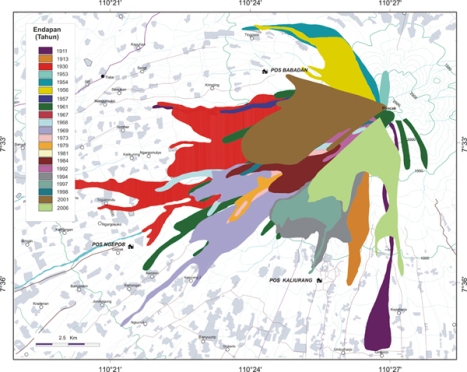
Peta menunjukkan sebaran endapan awanpanas Merapi 1911-2006. Hanya wilayah timur lereng yang bebas dari arah aliran awapanas dalam kurun waktu tersebut.
SEJARAH ERUPSI
Tipe erupsi Gunung Merapi dapat dikategorikan sebagai tipe Vulkanian lemah. Tipe lain seperti Plinian (contoh erupsi Vesuvius tahun 79) merupakan tipe vulkanian dengan daya letusan yang sangat kuat. Erupsi Merapi tidak begitu eksplosif namun demikian aliran piroklastik hampir selalu terjadi pada setiap erupsinya. Secara visual aktivitas erupsi Merapi terlihat melalui proses yang panjang sejak dimulai dengan pembentukan kubah lava, guguran lava pijar dan awanpanas (pyroclastic flow).
Merapi termasuk gunungapi yang sering meletus. Sampai Juni 2006, erupsi yang tercatat sudah mencapai 83 kali kejadian. Secara rata-rata selang waktu erupsi Merapi terjadi antara 2 – 5 tahun (periode pendek), sedangkan selang waktu periode menengah setiap 5 – 7 tahun. Merapi pernah mengalami masa istirahat terpanjang selama >30 tahun, terutama pada masa awal keberadaannya sebagai gunungapi. Memasuki abad 16 kegiatan Merapi mulai tercatat cukup baik. Pada masa ini terlihat bahwa waktu istirahat terpanjang pernah dicapai selama 71 tahun ketika jeda antara tahun 1587 sampai dengan tahun 1658.

Sejarah letusan gunung Merapi mulai dicatat (tertulis) sejak tahun 1768. Namun demikian sejarah kronologi letusan yang lebih rinci baru ada pada akhir abad 19. Ada kecenderungan bahwa pada abad 20 letusan lebih sering dibanding pada abad 19. Hal ini dapat terjadi karenapencatatan suatu peristiwa pada abad 20 relatif lebih rinci. Pemantauan gunungapi juga baru mulai aktif dilakukan sejak awal abad 20. Selama abad 19 terjadi sekitar 20 letusan, yang berarti interval letusan Merapi secara rata-rata lima tahun sekali. Letusan tahun 1872 yang dianggap sebagai letusan terakhir dan terbesar pada abad 19 dan 20 telah menghasilkan Kawah Mesjidanlama dengan diameter antara 480-600m. Letusan berlangsung selama lima hari dan digolongkan dalam kelas D. Suara letusan terdengar sampai Kerawang, Madura dan Bawean. Awanpanas mengalir melalui hampir semua hulu sungai yang ada di puncak Merapi yaitu Apu, Trising, Senowo, Blongkeng, Batang, Woro, dan Gendol.
Awanpanas dan material produk letusan menghancurkan seluruh desa-desa yang berada di atas elevasi 1000m. Pada saat itu bibir kawah yang terjadi mempunyai elevasi 2814m (;bandingkan dengan saat ini puncak Merapi terletak pada elevasi 2968m). Dari peristiwa-peristiwa letusan yang telah lampau, perubahan morfologi di tubuh Gunung dibentuk oleh lidah lava dan letusan yang relatif lebih besar. Gunung Merapi merupakan gunungapi muda. Beberapa tulisan sebelumnya menyebutkan bahwa sebelum ada Merapi, telah lebih dahuiu ada yaitu Gunung Bibi (2025m), lereng timurlaut gunung Merapi. Namun demikian tidak diketahui apakah saat itu aktivitas vulkanik berlangsung di gunung Bibi. Dari pengujian yang dilakukan, G. Bibi mempunyai umur sekitar 400.000 tahun artinya umur Merapi lebih muda dari 400.000 tahun. Setelah terbentuknya gunung Merapi, G. Bibi tertimbun sebagian sehingga saat ini hanya kelihatan sebagian puncaknya. Periode berikutnya yaitu pembentukan bukit Turgo dan Plawangan sebagai awal lahirnya gunung Merapi. Pengujian menunjukkan bahwa kedua bukit tersebut berumur sekitar maksimal 60.000 tahun (Berthomrnier, 1990). Kedua bukit mendominasi morfologi lereng selatan gunung Merapi.
Pada elevasi yang lebih tinggi lagi terdapat satuan-satuan lava yaitu bukit Gajahmungkur, Pusunglondon dan Batulawang yang terdapat di lereng bagian atas dari tubuh Merapi. Susunan bukit-bukit tersebut terbentuk paling lama pada, 6700 tahun yang lalu (Berthommier,1990). Data ini menunjukkan bahwa struktur tubuh gunung Merapi bagian atas baru terbentuk dalam orde ribuan tahun yang lalu. Kawah Pasarbubar adalah kawah aktif yang menjadi pusat aktivitas Merapi sebelum terbentuknya puncak.
Diperkirakan bahwa bagian puncak Merapi yang ada di atas Pasarbubar baru terbentuk mulai sekitar 2000 tahun lalu. Dengan demikian jelas bahwa tubuh gunung Merapi semakin lama semakin tinggi dan proses bertambahnya tinggi dengan cepat nampak baru beberapa ribu tahun lalu. Tubuh puncak gunung Merapi sebagai lokasi kawah aktif saat ini merupakan bagian yang paling muda dari gunung Merapi. Bukaan kawah yang terjadi pernah mengambil arah berbeda-beda dengan arah letusan yang bervariasi. Namun demikian sebagian letusan mengarah ke selatan, barat sampai utara. Pada puncak aktif ini kubah lava terbentuk dan kadangkala terhancurkan oleh letusan. Kawah aktif Merapi berubah-ubah dari waktu ke waktu sesuai dengan letusan yang terjadi. Pertumbuhan kubah lava selalu mengisi zona-zona lemah yang dapat berupa celah antara lava lama dan lava sebelumnya dalam kawah aktif Tumbuhnya kubah ini ciapat diawali dengan letusan ataupun juga sesudah letusan. Bila kasus ini yang terjadi, maka pembongkaran kubah lava lama dapat terjadi dengan membentuk kawah baru dan kubah lava baru tumbuh dalam kawah hasil letusan. Selain itu pengisian atau tumbuhnya kubah dapat terjadi pada tubuh kubah lava sebelumnya atau pada perbatasan antara dinding kawah lama dengan lava sebelumnya. Sehingga tidak mengherankan kawahkawah letusan di puncak Merapi bervariasi ukuran maupun lokasinya. Sebaran hasil letusan juga berpengaruh pada perubahan bentuk morfologi, terutama pada bibir kawah dan lereng bagian atas. Pusat longsoran yang terjadi di puncak Merapi, pada tubuh kubah lava biasanya pada bagian bawah yang merupakan akibat dari terdistribusikannya tekanan di bagian bawah karena bagian atas masih cukup kuat karena beban material.
Lain halnya dengan bagian bawah yang akibat dari desakan menimbulkan zona-zona lemah yang kemudian merupakan pusat-pusat guguran. Apabila pengisian celah baik oleh tumbuhnya kubah masih terbatas jumlahnya, maka arah guguran lava masih dapat terkendali dalam celah yang ada di sekitarnya. Namun apabila celah-celah sudah mulai penuh maka akan terjadi penyimpangan-penyimpangan tumbuhnya kubah. Sehingga pertumbuhan kubah lava yang sifat menyamping (misal, periode 1994 – 1998) akan mengakibatkan perubahan arah letusan. Perubahan ini juga dapat terjadi pada jangka waktu relatif pendek dan dari kubah lava yang sama. Pertumbuhan kubah lava ini berkembang dari simetris menjadi asimetris yang berbentuk lidah lava. Apabila pertumbuhan menerus dan kecepatannya tidak sama, maka lidah lava tersebut akan mulai membentuk morfologi bergelombang yang akhirnya menjadi sejajar satu sama lain namun masih dalam satu tubuh. Alur pertumbuhannya pada suatu saat akan mencapai titik kritis dan menyimpang menimbulkan guguran atau longsoran kubah. Kronologi semacam ini teramati pada th 1943 (April sampai Mei 1943).
Penumpukan material baru di daerah puncak akibat dari pertumbuhan kubah terutama terlihat dari perubahan ketinggian maksimum dari puncak Merapi. Beberapa letusan yang dalam sejarah telah mengubah morfologi puncak antara lain letusan periode 18221823 yang menghasilkan kawah berdiameter 600m, periode 1846 – 1848 (200m), periode 1849 (250 – 400m), periode 1865 – 1871 (250m), 1872 – 1873 (480 – 600 m), 1930, 1961.
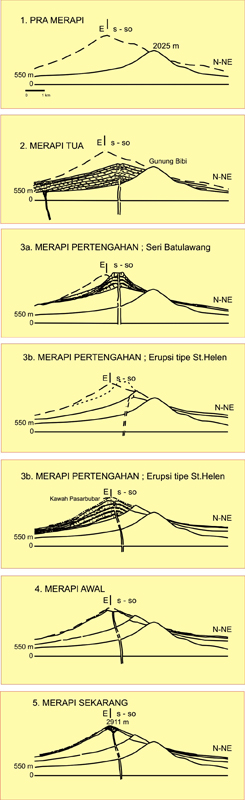
Subscribe to:
Posts (Atom)